Hunting for Harmonie

Located in the very southern “toe” of Indiana near the historic utopian community at New Harmony, Harmonie State Park was my first stop in this year’s quest to visit six of the most recent additions to Indiana’s park system. Established in 1966, Harmonie’s 3,465 acres border Illinois and the Wabash River on its way to a rendezvous with the Ohio. With its river views, olympic-size pool, multiple picnic areas and 200-site campground, Harmonie provides plenty of outdoor entertainment.

Due to heavy rains and flooding my original date for visiting had to be pushed back a week until the flood waters receded. The park had only been open for two days when I arrived on Saturday morning, May 20th during a very active thunderstorm. Luckily the storm moved through quickly and I was able to venture down to the dock of the Little Harmonie Pond, taking only my watercolor kit, a sketchbook and my camp chair just in case there was more rain on the way.

I quickly started working on a view of the pond including one of the beautiful blue benches that reflected so well in the still water. Before long a group of boy scouts and their leaders from nearby Evansville appeared with fishing gear and poles to try their luck at the pond. I enjoyed watching the young fishermen cast their lines and listened to their friendly banter while waiting for a bite. I was able to get a good start on the painting by the time I was scheduled to head over to the Nature Center.

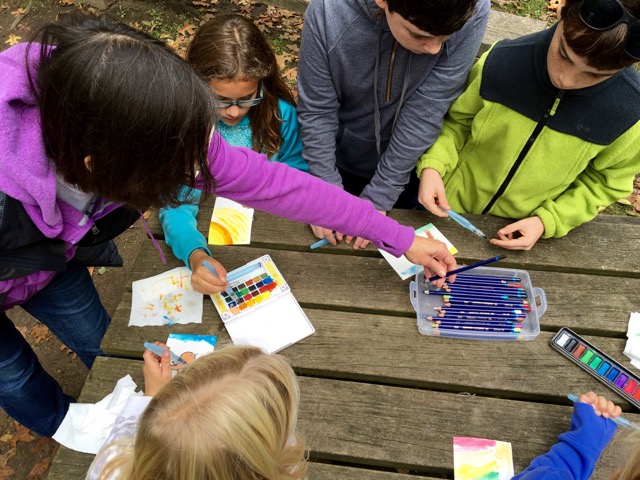
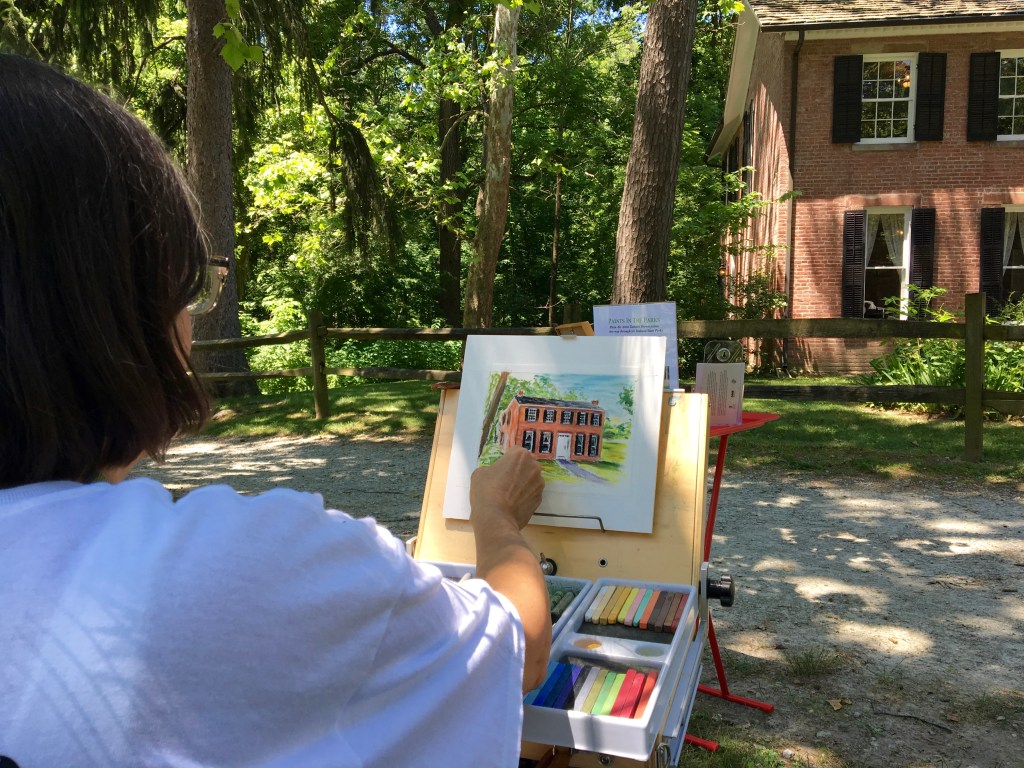
The sun was just beginning to peek out while I set up for the watercolor painting activity under some shade trees next to the building. Facing the campgrounds, I was able to entice young and old alike to grab a paint set, water brush and an assortment of Inktense pencils, Micron pens and (new this year) watercolor crayons. Visitors were able to sit at several brand-new picnic tables nearby and spend a leisurely hour or so painting and chatting with friends and family while listening to the sounds of nature surrounding them. Around fifteen children and grownups stopped by to paint and let me take their photos while proudly displaying their artwork.

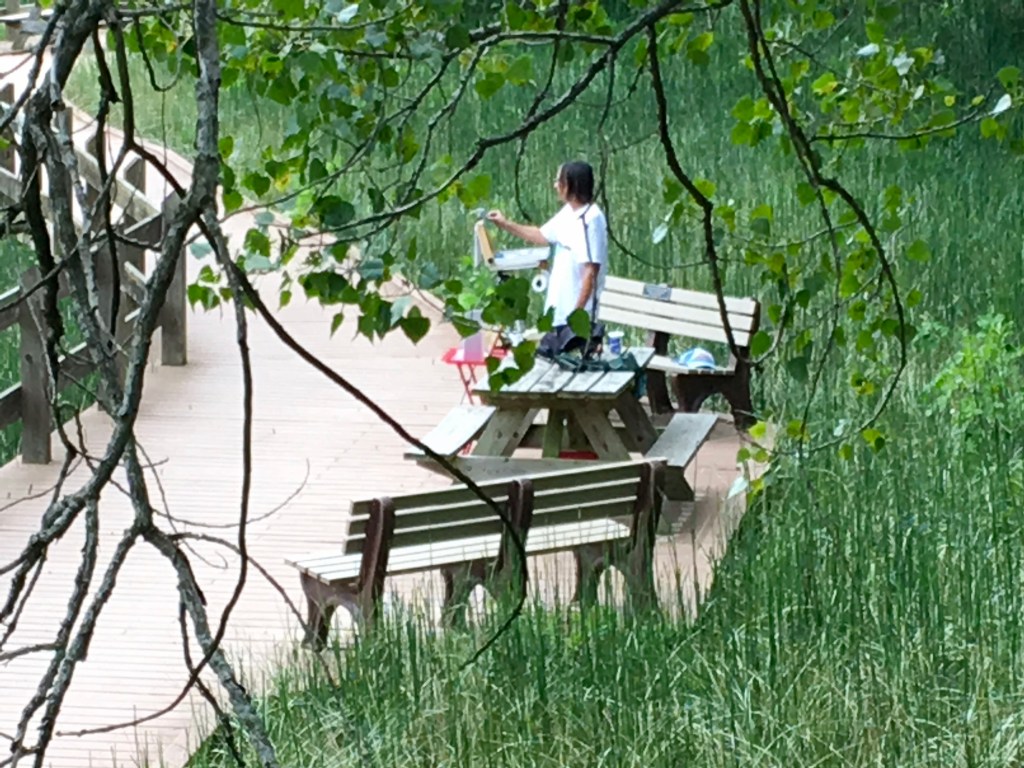
For the afternoon demonstration I set up along the Wabash River which was still very high and had overflowed its banks just a few days earlier. In fact the spot I’d chosen to place my easel had clearly been underwater at some point. But with a good coating of bug spray I was blocking out color in no time under some lovely shade trees overlooking a scenic stretch of the river.

Just in time too because I was placed at the river for a reason. For the first time ever I was actually part of a photo scavenger hunt. Participants had to find the artist and take a picture with me and my painting as one of a long list of clues. Not only was this an excellent way to see the park and learn about all the features you might otherwise miss, but I had the opportunity to interact with visitors and show them some plein air painting in action. Scavenger hunters had a chance to compare what I was painting and note my use of colors you wouldn’t expect. For instance instead of brown or blue water, the surface of the river had a pink glow in the afternoon light that day and everyone could really see that.

All totaled I visited with about 55 guests for my first park, many of them braving the damp conditions to camp that weekend. Considering that half the state had canceled all kinds of plans for the weekend because of the wet weather, I call that a success!
Pastel Pursuits at Turkey Run

The next stop in the countdown to my 2017 visits to Indiana’s state parks goes back to a beautiful day in July at the unique Turkey Run State Park. Easily the most visited state park in Indiana, I spent a productive morning at the busiest spot at Turkey Run — the suspension bridge over Sugar Creek. You couldn’t ask for a better position to engage the public. I broke all attendance records for the morning alone!

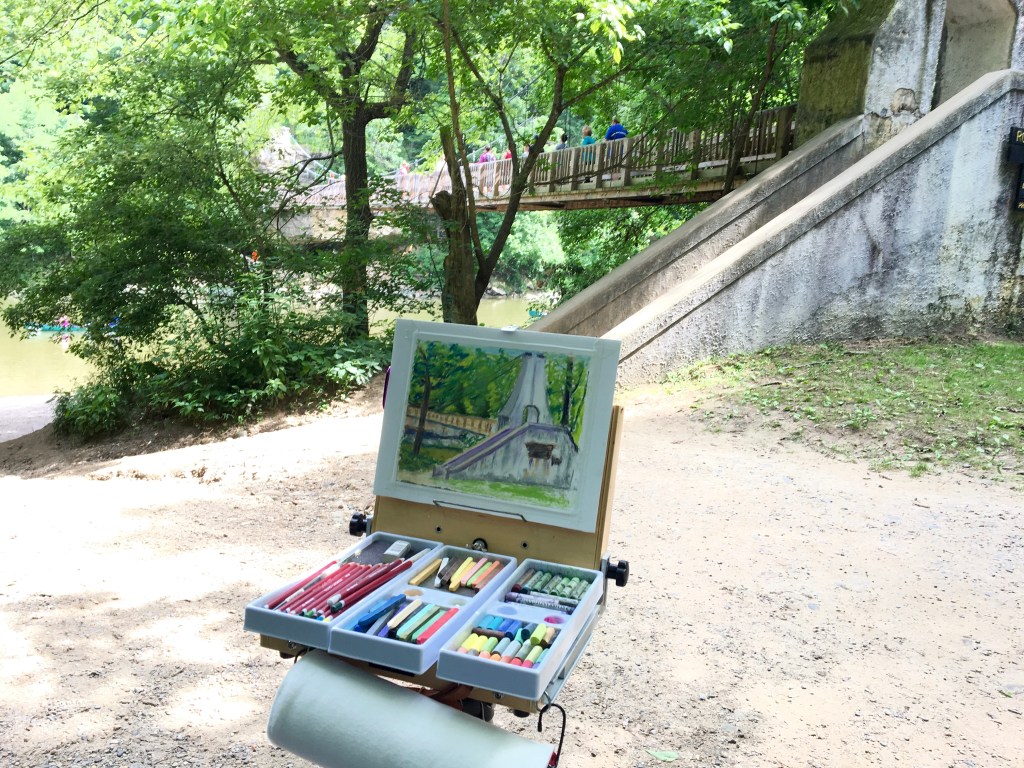
In order to visit most of the dramatic cliffs and canyons in the park you must cross the creek over a bridge that does move a bit depending on the wind and traffic. I set up for the morning in the cool shade of a convenient clearing in view of everyone hiking up and down the steps of the mossy concrete support for the cables that hold up the foot bridge. Even with many pauses to chat with visitors at this visible spot I made enough progress on my painting that people could recognize what I was working on.

I chose to paint with pastels that morning and had already prepared a piece of sanded 8″ x 10″ Wallis pastel paper secured with white artist tape to a piece of foam board. I’m able to clip this setup to the easel of my pochade box the same way I do my panels for oil painting. That way when I’m finished and need to move on I can carry the pastel clipped to the outside of the box or place it in one of the plastic bins I bring along to protect the fragile pastels from the elements and keep everything else away from the dust.

I use several brands of soft or chalk pastels although I’ll be experimenting with oil pastels in 2017. I have used the firmer Prismacolor NuPastel sticks since college and prefer them for crisper edges and a wide variety of colors at a reasonable price. I also use Derwent pastel pencils for clean, sharp lines and details. A few years ago a painting teacher at my local art center introduced me to Rembrandt pastels which are softer and pricier. After enjoying the depth of color I’ve achieved with these I finally took the plunge and bought a few of the very expensive Sennelier soft pastels in buttery, darker shades. I’ve learned the hard way that you have to pay big bucks for those very necessary dark shades that pop the lighter colors and add depth to your painting.

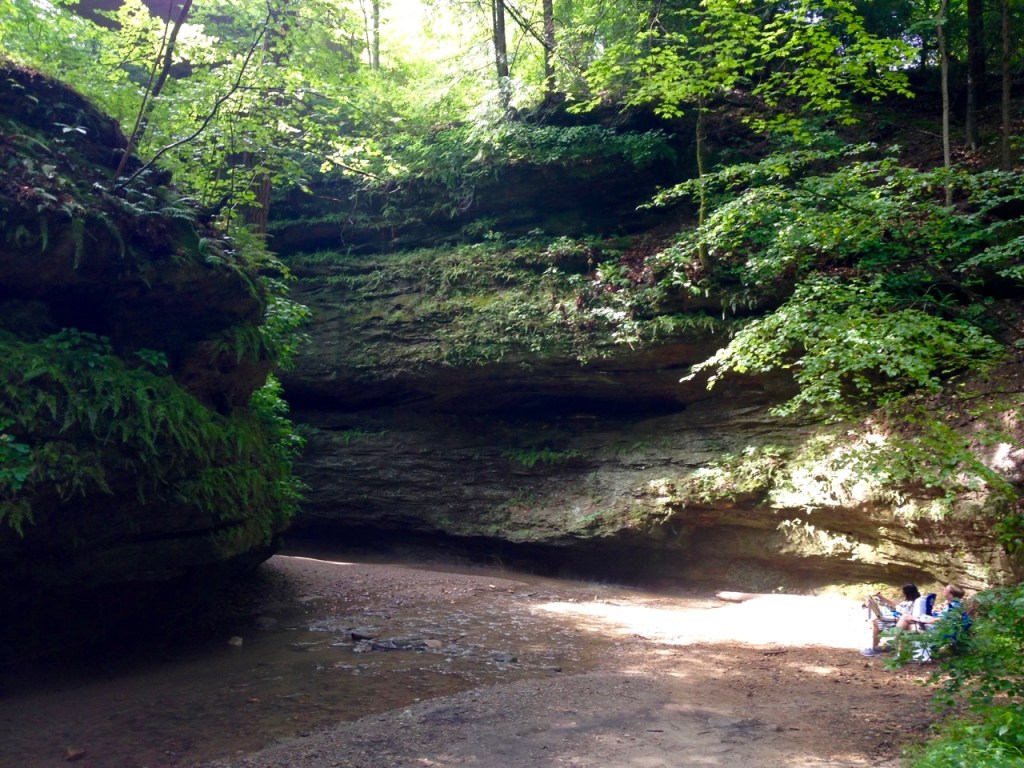
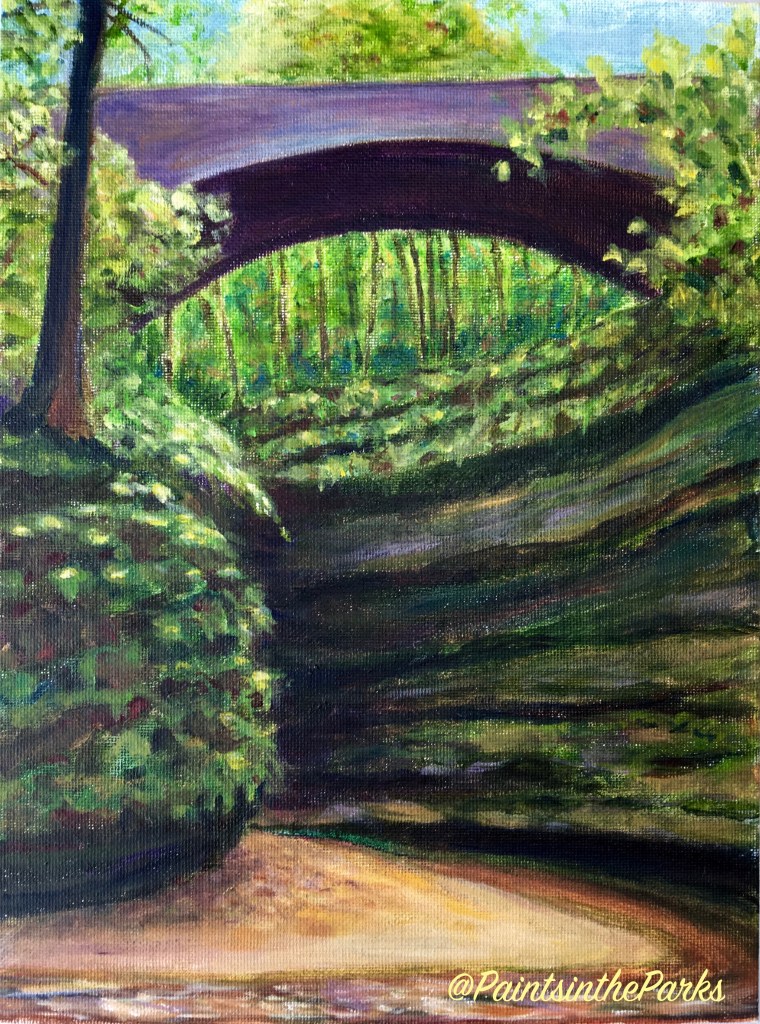
After taking shelter under the nature center’s covered porch for a big thunderstorm, I hauled only the basics (my pochade box and a camp chair) down the many steps to the bottom of Turkey Run Canyon. Perched on the edge of the swollen creek I began an oil painting on a 9″ x 12″ panel while hikers tried to cross over on the few remaining rocks jutting out of the water. Few made it across without getting their feet wet. Meanwhile I tried to replicate the beautiful saturated colors left by the rains as the sun’s rays hit all the water particles suspended in the air, turning them to diamonds.

Neither photo nor painting could do justice to the enchanting scene I hoped to capture that afternoon. I hope to remember it always, and now have a completed painting to help jog my memory. I particularly enjoyed painting all the warm colors found in the water, pebbles and sand as complements to the cool blues and purples of the canyon walls and woods.

Keep an eye out for a change of pace and completely different scenery when I head up to the sand dunes of Lake Michigan for my next installment. Until then, happy creating!

Countdown to the Parks

The grass is greening, tree buds are bursting, geese have returned (well, they never actually left), and warm spring breezes are calling to make art outdoors. I have another Arts in the Parks Grant for 2017, this time in six of the newest state parks throughout Indiana. In preparation I’m finishing and featuring the paintings from visits last year, one set of park paintings per week until the official kick-off for my Paints in the Parks event the first weekend of May.

This week’s completed works are from my very first 2016 Paints in the Parks event on Memorial Day Weekend last May. I nervously set up my easel and supplies by the edge of Big Clifty at the most popular spot in Clifty Falls State Park near Madison, Indiana. I’d just been informed that a well-known Indiana photographer for Outdoor Indiana magazine was coming to take photos of me painting by the falls.

Working against the clock, I quickly located a good angle, framed the composition in my mind, and chose an appropriately sized panel. By the time photographer Frank Oliver arrived I had roughly blocked in all areas and was working on details, trying to capture the movement of that rushing water over rocks, all while chatting with park visitors and trail hikers.

When it was time for me to move on to my next spot in the park, I was close to completing the painting, needing only a few touchups when I returned home. This particular one of Big Clifty, of all my 2016 park paintings, is truly a work of plein air, capturing the movement and lighting in that fleeting moment. All because of the threat of being documented with an ugly canvas. Guess I work better under pressure.

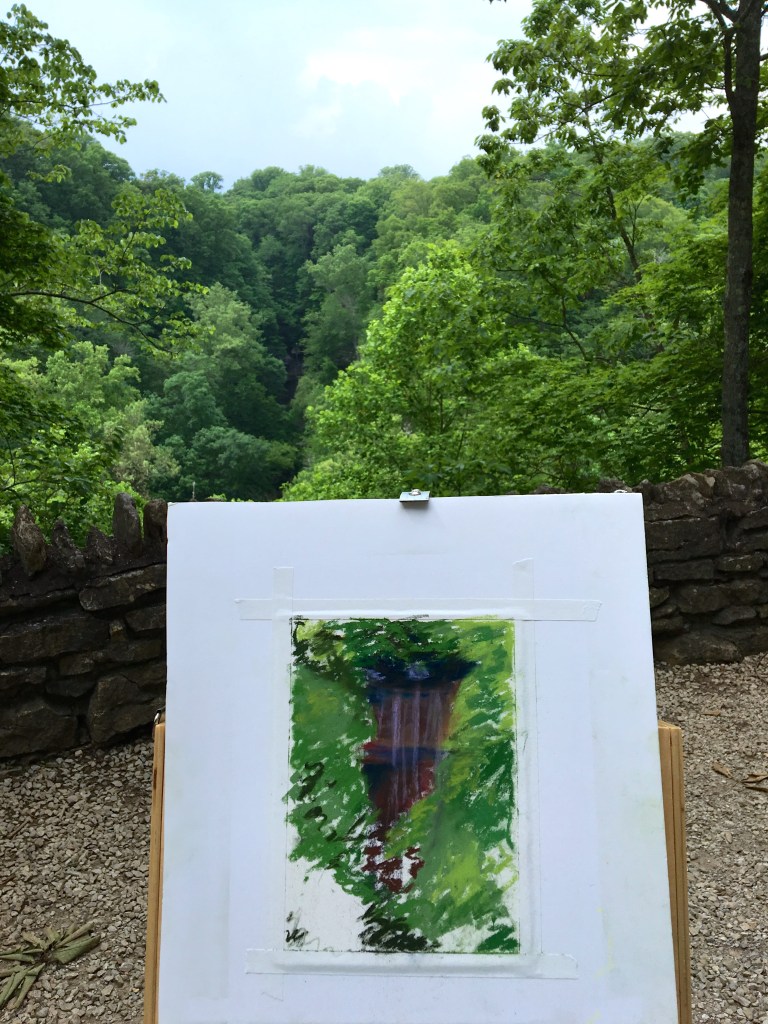
In late afternoon I was set up across the canyon from Big Clifty on a trail that provided a dramatic lookout over the sea of green canopy. Through a distant slit in the leaves you could catch a glimpse of Big Clifty’s distinctive rocky cliffs and falls. By now I was becoming more comfortable engaging with the steady stream of hikers who paused to take a breath after a steep climb out of the canyon. The muggy weather threatened rain all day but now the heat and humidity were building up for an afternoon thunderstorm so I was watching the skies closely.

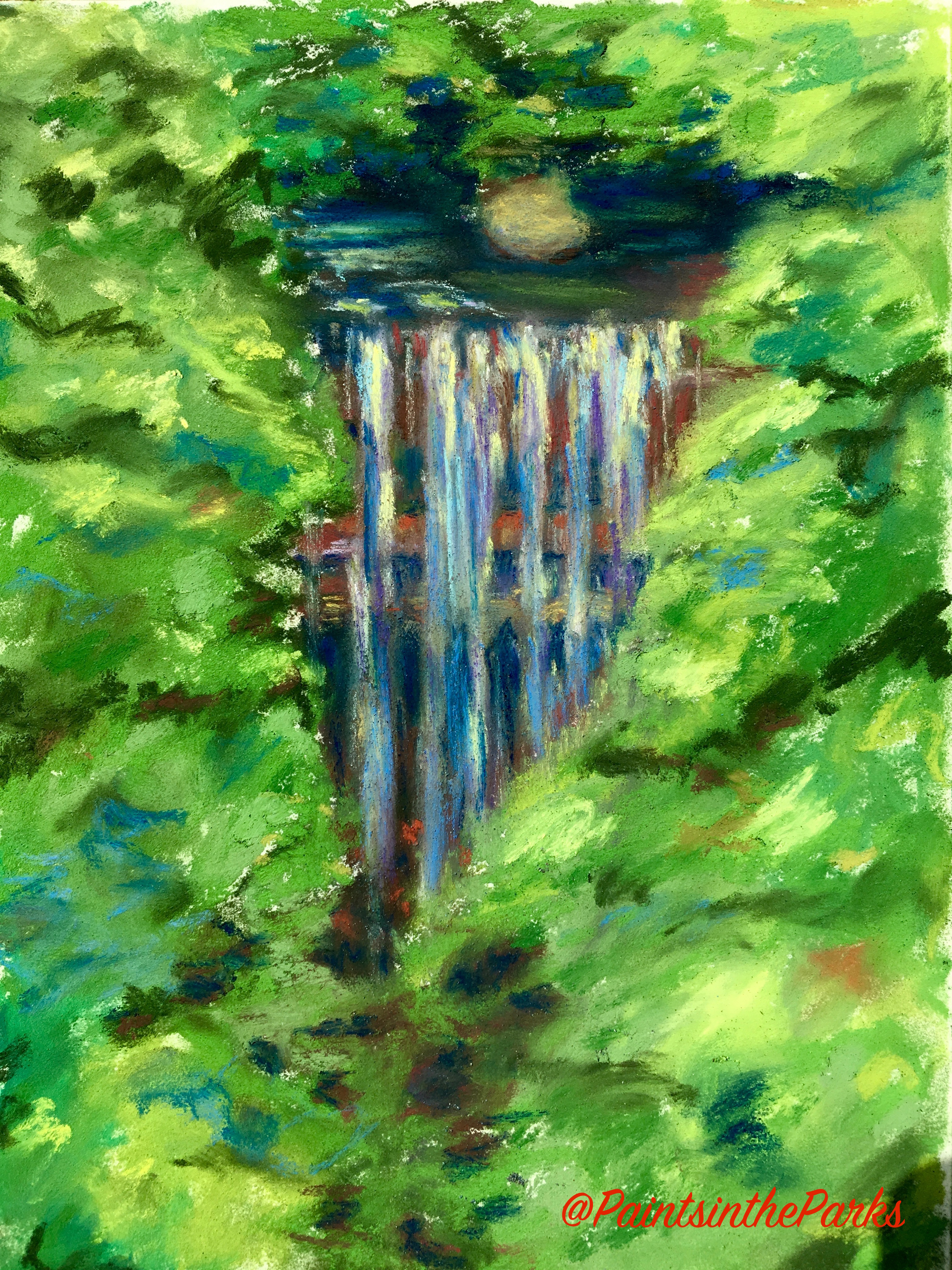
Despite all the moisture I chose to try my hand at some pastel work while chatting with curious visitors who peered around my easel to see what I was doing. Before the visit I had prepared a piece of sanded pastel paper, cut to a small standard size and taped to some foam board for stability. That way I could secure the painting surface by clipping it to my pochade paint box like any other canvas. The danger with pastels is always the possibility of knocking costly pastel sticks to the ground and breaking them but I managed to keep them steady for a quick impression of the falls before the skies finally opened up. I then took the work in progress home to finish in drier conditions.

I find that I enjoy producing several versions of the same subject using different mediums. The chance to introduce to the public a variety of ways to paint and make art is worth hauling so many supplies into the state parks and up rugged trails. The countdown continues next week so stay tuned for another set of finished paintings from last June. Until then, happy creating!

Falling Water

Painting at a safe distance with pastels on an 8 x 10" Ampersand pastelboard.
Painting at a safe distance with pastels on an 8 x 10″ Ampersand pastelboard.

During my painting events in state parks this year visitors kept recommending that I visit Cataract Falls State Recreational Area, an easy drive from Indianapolis on I-70 near Cloverdale, Indiana. Whenever I mentioned my love of painting water in its many forms, the answer was often, “Oh then you need to paint Cataract Falls. They’re the best in Indiana!” After my visit earlier this month on a gorgeous Saturday afternoon I can tell you that those claims aren’t exaggerated.

A robust Mill Creek feeds the upper and lower sets of waterfalls which run over two ridges of pre-glacial bedrock, boasting the greatest volume of water (and sound) of any waterfall in the state. Both upper and lower falls provide plenty of good views for painting but I settled on a spot at the edge of the ravine below the upper falls apart from the viewing platforms and steady stream of foot traffic. There is also a historic red covered bridge that crosses the creek nearby featuring a unique lattice-pattern truss system. I hope to paint it and the lower falls when I return.

The irony is that my family and I used to live just up the road years ago, and never knew about this hidden treasure. Now that we have been captured by its charms we will definitely come back to Cataract Falls in the future.

Praise for Pokagon

I couldn’t have asked for a better finale to cap off my 2016 Arts in the Parks grant than my final program at Pokagon State Park near Angola, Indiana. Located in Indiana’s lake country at the very northeast corner of the state, Pokagon borders two natural lakes and was named for the last notable leaders of the Potawatomi native people who sold one million acres to the federal government (including the area that became Chicago) for the price of three cents an acre.

The park offers two beaches, 12 miles of trails, wooded hills, wetlands, open meadows and even a toboggan run built by the CCC in the 1930s. The lakes as well as the marshes, fens, swamps, pine groves and other unique ecotypes typical of more northern regions were created by one of the last glaciers to cover Indiana ten thousand years ago. Land that was farmed decades ago has been allowed to return to its natural state and the nearby Trine recreational area added in 2007 complements Pokagon as part of local and statewide efforts in land and water preservation.

I spent a chilly but pleasant morning painting on the pier at Lake Lonidaw, a kettle-hole lake formed when sunken blocks of ice broke away as the glacier melted. The mat of reedy vegetation along the edges fools you into thinking this is a stagnate pond when in reality this constantly moving body of water drops off to a depth of 30 feet. Armed with a cup of hot coffee and plenty of duct tape to keep my supplies from flying into the lake, I made good progress capturing fall foliage in oil, saw a great blue heron glide by, heard plenty of red-winged blackbirds, and engaged with a morning tour group led by a Pokagon interpretive naturalist.

At noon in a wonderful gathering area full of comfortable tables and benches outside the nature center, I received a tremendous response to my watercolor painting activity with over 40 kids and adults trying out my watercolor kits, water brushes, Inktense watercolor pencils and Micron drawing pens with ink that doesn’t run when you paint over it. By far the largest turnout of all the park events, I’m pleased to say that every piece of watercolor paper I brought was used and some wonderful connections were made including a family who just happened to stop by on their way to Ohio to see their son in college, a little girl who spent two hours on a beautiful tree inspired by something in my sketchbook, and a student from an Indianapolis art institute who is adding her watercolor painting to a school art project focusing on geography.

I finished the day at the Potawatomi Inn beach on Lake James with the sun casting interesting shadows on the little boat house I was painting and the brisk fall breeze spurring on the little white-capped waves that raced to shore. I had some great leisurely conversations with curious visitors and interested painters about my painting subjects, equipment and set up. All told, I engaged with over 100 park visitors during my final painting event with the added treat of spending a long weekend at the beautiful Potawatomi Inn built in 1927. Many thanks to DNR naturalist Marie Laudeman and the rest of the park and inn staff for such a successful and pleasant visit; and to the Indiana Department of Natural Resources, the Indiana Arts Commission and the Indiana Bicentennial Commission for their support throughout my 2016 Arts in the Parks grant.

My painting programs may be completed for the year but I’ll still be painting outside whenever there’s a good day this fall (and maybe even winter) while I continue to finish the paintings I began at all the wonderful state parks I had the privilege to visit this year. As a way to brighten up bleak winter days I’ll also be working on new paintings inspired by the wildflowers I photographed on my walks along the trails. So, stay tuned for regular updates to Paints in the Parks and thanks for following along.

Water Works at Spring Mill

Our battles with weather continued at my fifth painting event in Spring Mill State Park last weekend. Despite a severe thunderstorm watch in the iffy forecast I decided to take a chance and make the two-hour drive to this beautiful 1,350-acre haven for virgin timber, cave springs and a restored pioneer village — and I’m so glad I did!

Keeping an eye on the sky I set up at Twin Caves for my morning painting session chatting with the fearless visitors waiting for boat rides into the one of two cave openings, hence the location’s name. Even though the day was rapidly becoming warm and muggy, the air dropped twenty degrees by the time you descended many stone steps to the boat dock. The change in temperature was so drastic that my glasses steamed up every time I ascended to the parking lot.

While painting, I also talked with the park staff who take folks into the dark waters of the cave to see rock formations, an endangered species of blind fish, lizards and other creepy crawlies. (Can’t think of anything better for the nature nerd but nothing worse for those who are claustrophobic and terrified of watery darkness.) Although I didn’t have time to go myself I was assured that it was very safe, and indeed, all who entered came out the day I was there.

For my oil painting that morning I chose the point where two fallen trees converged in the water providing a little island of greenery. I made a good start capturing reflections in the water as well as the perspective of those two logs resting diagonally on the very steep bank, upright but not standing as living trees. Speaking of trees, even though I didn’t paint in Donaldson Woods this trip, on recent visits I have walked in awe through the grove of 300-year-old native trees protected thanks to the efforts of a Scotsman named George Donaldson who purchased the forest in 1865.

My next stop at noon was outside the Lakeview Activity Center adjacent to recently restored Spring Mill Lake, built by the Civilian Conservation Corps as part their good work in the 1930s along with shelters, roads, trails and the lovely stone inn at Spring Mill. Under fast-moving skies that fluctuated between cloudy and clear, 15 visitors stopped by to try out my water brushes and watercolor kits. For those who weren’t inclined to be artistic that day there was the option of a competitive round of Cornhole right next to the art table. Unfortunately a sudden deluge cut short our art efforts, but I’m very grateful for the canopy provided by the DNR staff that protected my art supplies and saved my paintings from ruin.

The drizzly afternoon was spent quietly at Spring Mill’s pioneer village, a restored collection of buildings that exemplifies early 1800’s industrial technology showcased by the beautiful three-story grist mill built in 1817 to take advantage of a constant source of water from several cave springs that never freeze. I was able to work on my pastel painting of the mill by taking cover in the convenient breezeway (called a “dogtrot”) of the Granny White Cabin where I was still able to engage with twenty or more kids and adults while they strolled the village under umbrellas. While I was busy drawing there was a sawing demonstration and turning of the mill’s enormous wheel, all moved by the force of rushing spring water from Hamer’s Cave down the stone-pillared flume.

In spite of the weather’s shenanigans I was able to connect with over 80 park guests on Saturday, which I considered successful enough to treat myself and family to an excellent buffet dinner at the Spring Mill Inn before heading home. And you too will find plenty to do at Spring Mill to earn that good night’s rest at the Inn. Besides the attractions I’ve just mentioned, other park features include a pioneer cemetery, an extensive collection of artifacts housed in the mill, numerous caves and wooded trails, and a monument erected by Donaldson to honor the ornithologist Alexander Wilson. Just within the park’s gates there’s also a monument to Gus Grissom, celebrated astronaut from nearby Mitchell who died along with two other astronauts during a pre-launch test for the Apollo 1 mission at Cape Canaveral. The adjacent museum houses his Gemini III capsule and spacesuit among other items.

Even though I bid farewell for now to the park, I’ll be back next year to continue painting the historic grist mill as part of its 200th birthday celebration. Through changing seasons (and weather), no matter how many times I visit, there’s always something new to discover at Spring Mill State Park.

Drama at the Dunes

My good luck with weather finally came to an end at the fourth park on my Paints in the Parks schedule this year. Saturday began with ominous forecasts and strong winds in advance of a cold front bringing severe storms to the Chicago area first and then to Indiana Dunes State Park, located about 50 miles east and surrounded by the Indiana Dunes National Lakeshore. Fortunately I usually book Sundays as possible rain dates and in this case I was so glad I did!

My first stop Sunday morning under dramatic skies was the bird observation platform with views of the Dunes Prairie Nature Preserve and some of the three miles of beach along Lake Michigan’s southern shore. I enjoyed capturing shifting cloud formations that determined what colors appeared on the lake’s surface. A stiff northern breeze even worked up some whitecaps for me to practice painting although the rough water and high tide that day ruled out swimming, much to the Sunday beachgoers’ disappointment.

Midday was spent at the Nature Center where nature hikes, beach yoga, shipwreck stories and a bird watercolor workshop were among the many activities featured at this busy state park that encompasses over 1500 acres of beach, sand dunes, black oak forest, marsh and wooded wetlands. A steady stream of adults and children stopped by my table to try out the water brushes and special Inktense watercolor pencils I brought along for an outdoor watercolor activity. Over 20 brave individuals took up my challenge to paint in the park and some even let me take their picture showing off their wonderful works of art.

I finished off the afternoon working with pastels on pastel board along the boardwalk overlooking a button-bush marsh connecting the beach access to a very busy campground. Overall I interacted with 70 visitors to the park, many from the Chicago area. I particularly enjoyed meeting quite a few college students relaxing at the Dunes before heading back to school.

While I made good progress on the two works I began that day, I need to come back and paint the other unique habitats and diverse landscapes preserved in this state park established in 1925. In fact the father of ecology, Henry Cowles, conducted landmark research on the flora and fauna here putting Indiana Dunes on the map as “the birthplace of ecology.” I hope to return soon prepared to make the steep climb up some of those “moving” dunes for that dramatic view that’s well worth the effort.

The Mists of Turkey Run

July’s painting event at Turkey Run State Park featured all the best of a summer day: beautiful weather, an afternoon thunderstorm, an ice-cream social, and a mystical time inside those famous hollows used by pioneers to corral wild turkeys for hunting, hence the name for one of the busiest state parks in Indiana.

The second park to be established in Indiana’s state park system, Turkey Run’s sandstone bedrock was carved into canyons and formations by the glaciers that brought boulders and plant life only seen in northern areas of Michigan and Canada. The hemlock groves and canyon ecosystems are found nowhere else in Indiana. This park is also the final resting spot for Col. Richard Lieber, father of Indiana State Parks, and home to the 19th Century Lusk Home, the Lieber Cabin built with virgin timber in the 1840s, and the Log Church built in 1871. There is also a covered bridge over Sugar Creek and a suspension bridge that leads to the sandstone canyons and rugged trails.

I set up at the suspension bridge in the morning, and used pastels to capture the steps and concrete base with a glimpse of the creek as many visitors strolled by on a beautiful Sunday. I had some great conversations about what I was doing throughout the morning, meeting many who were creative artists in their own way including a blacksmith and a quilter. I saw over 140 visitors for the day, my most successful event yet.

My watercolor activity at the Nature Center around noon was also a big hit with over 25 kids and adults trying out water brushes and field kits despite the afternoon thunderstorm that cut my time short. After a brief stop for the 100th birthday celebration with cake and ice cream at the Inn, I descended with only my paintbox and a camp chair to the entrance of Turkey Run Hollow where the cool creek water and saturated air from the thunderstorm met to form the most beautiful mists and light rays that cut through the dampness. Hikers paused to chat by my chair before attempting the trail’s precarious water crossing.

There’s so much to see at Turkey Run that I’m sure I’ll return soon to paint its wonderful covered bridge or the waterfalls in hidden canyons full of dense green ferns and moss. Until then, I’ll treasure the memories of a perfect summer day and the glimpses of a mystical world brought by glaciers.

Magic at Mounds

My visit to Mounds State Park last Saturday was full of sunshine, painting and chats about art with new park friends. One of the smallest parks in the Indiana state park system, Mounds isn’t as well known as some of its larger and more scenic counterparts but the mysterious earthworks resting amid wooded trails and the White River, as well as the historic Bronnenberg House, make a visit to the Mounds worthwhile.

This 290-acre park features 10 unique earthworks built by prehistoric Indians known as the Adena-Hopewell people. The largest earthwork, the Great Mound, is believed to have been constructed around 160 B.C. Archaeological surveys indicate the mounds were used as gathering places for religious ceremonies from where astronomical alignments like the summer and winter solstices can be viewed.

The Federal-style Bronnenberg House is a lasting reminder of early settlers who recognized the uniqueness of this area and protected the earthworks from looters and farming practices. Despite the construction of an amusement park and railroad in the early 1900s, the Bronnenberg family actively fought to preserve the mounds. Along with the house, the prehistoric earthworks became part of the state park in 1930. The fully-restored brick structure seen today was originally built around 1850 and is open for tours.

Throughout the day over 85 visitors stopped or strolled by and I had the pleasure of creating art at the Great Mound in the morning with two new friends who brought their own art supplies ready to draw! In the afternoon 20 kids and adults took me up on my challenge to try out the waterbrushes and watercolor field kits. After attending a birthday party celebrating the Centennial of the Indiana state parks, we stuck around for drumming and dance by the Miami Nation of Indiana that took place inside the Great Mound this year.

Like the Bronnenbergs I recognize the uniqueness of this particular park and its earthworks. Painting in this ancient place fills me with peace and a sacred sense of wonder. Often overlooked despite its close proximity to Indianapolis and I-69, I chose this particular park to bring attention to its beauty and special charm, grateful to those who protected and preserved the Mounds’ special magic over the years.

Falling For Clifty Falls

This past Memorial Day weekend found me painting up a storm at Clifty Falls State Park near the mighty Ohio river and Madison, Indiana. Created by Ice Age glaciers millions of years ago, the waterfall that has cut away the soft shale from hard limestone bedrock can be found some two miles away from where it first began on the Ohio river banks leaving a deep canyon in its wake. Sixty feet high and supplied by this year’s ample spring rains, I could hear the roar of Big Clifty while I set up my easel for the morning demonstration.

My painting spot was one of several prime viewing areas protected by stone walls built in the 1930s by the Civilian Conservation Corps where Brad Hessans, the park’s very knowledgeable interpretive naturalist, stopped to point out fossils embedded in the stones. Creek beds and rock formations throughout the park hold many examples of fossils from an ancient marine ecosystem full of corals and brachiopods.

The campgrounds and inn were also full at Clifty for the holiday weekend and I was able to engage over one hundred visitors throughout the day on Saturday at several locations in the park. I worked on a small oil painting of the Falls in the morning and a pastel of a long-range view of Clifty Falls from a lookout point on the trail in the afternoon. The trails range from rugged to easy and there’s plenty to do in the park as well as the nearby cities of Madison and Louisville.

Established in 1920 at the suggestion of Richard Lieber, father of the Indiana state park system, Clifty Falls is the first of six state parks I’ll visit this summer and fall. If you get the chance I encourage you to come visit Clifty’s stunning waterfalls and scenic overlooks. My next stop in June is Mounds State Park near Anderson, Indiana. Until then, grab some supplies and go make some art outside!