

Located in the very southern “toe” of Indiana near the historic utopian community at New Harmony, Harmonie State Park was my first stop in this year’s quest to visit six of the most recent additions to Indiana’s park system. Established in 1966, Harmonie’s 3,465 acres border Illinois and the Wabash River on its way to a rendezvous with the Ohio. With its river views, olympic-size pool, multiple picnic areas and 200-site campground, Harmonie provides plenty of outdoor entertainment.
Due to heavy rains and flooding my original date for visiting had to be pushed back a week until the flood waters receded. The park had only been open for two days when I arrived on Saturday morning, May 20th during a very active thunderstorm. Luckily the storm moved through quickly and I was able to venture down to the dock of the Little Harmonie Pond, taking only my watercolor kit, a sketchbook and my camp chair just in case there was more rain on the way.
I quickly started working on a view of the pond including one of the beautiful blue benches that reflected so well in the still water. Before long a group of boy scouts and their leaders from nearby Evansville appeared with fishing gear and poles to try their luck at the pond. I enjoyed watching the young fishermen cast their lines and listened to their friendly banter while waiting for a bite. I was able to get a good start on the painting by the time I was scheduled to head over to the Nature Center.
The sun was just beginning to peek out while I set up for the watercolor painting activity under some shade trees next to the building. Facing the campgrounds, I was able to entice young and old alike to grab a paint set, water brush and an assortment of Inktense pencils, Micron pens and (new this year) watercolor crayons. Visitors were able to sit at several brand-new picnic tables nearby and spend a leisurely hour or so painting and chatting with friends and family while listening to the sounds of nature surrounding them. Around fifteen children and grownups stopped by to paint and let me take their photos while proudly displaying their artwork.
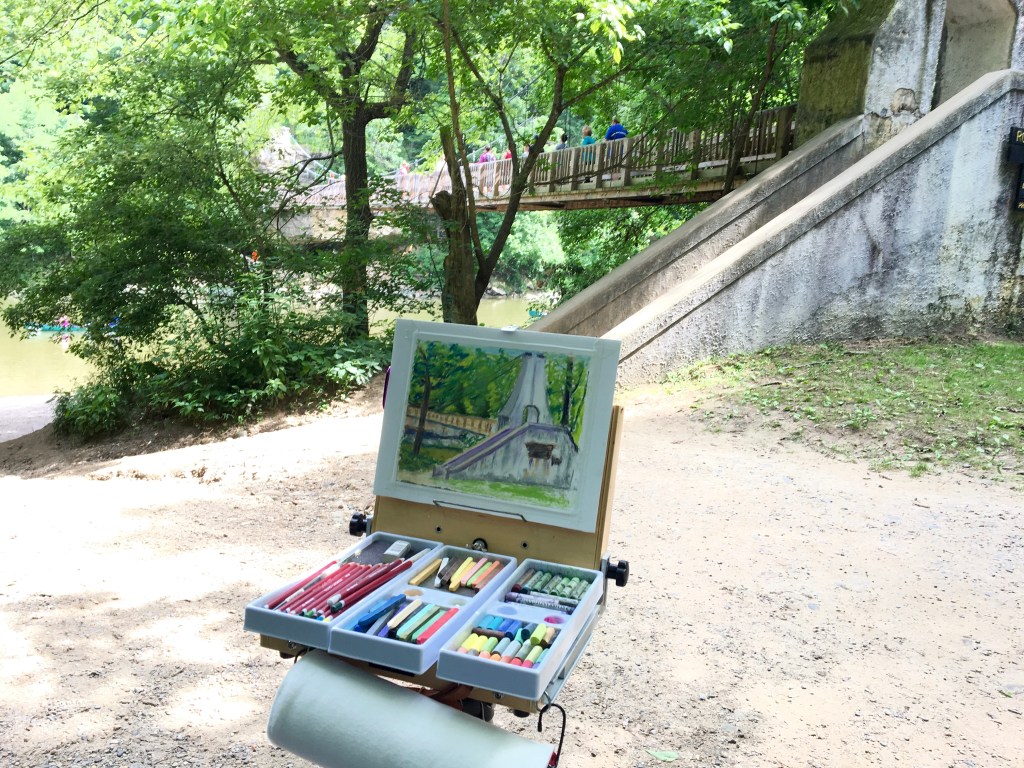
For the afternoon demonstration I set up along the Wabash River which was still very high and had overflowed its banks just a few days earlier. In fact the spot I’d chosen to place my easel had clearly been underwater at some point. But with a good coating of bug spray I was blocking out color in no time under some lovely shade trees overlooking a scenic stretch of the river.
Just in time too because I was placed at the river for a reason. For the first time ever I was actually part of a photo scavenger hunt. Participants had to find the artist and take a picture with me and my painting as one of a long list of clues. Not only was this an excellent way to see the park and learn about all the features you might otherwise miss, but I had the opportunity to interact with visitors and show them some plein air painting in action. Scavenger hunters had a chance to compare what I was painting and note my use of colors you wouldn’t expect. For instance instead of brown or blue water, the surface of the river had a pink glow in the afternoon light that day and everyone could really see that.
All totaled I visited with about 55 guests for my first park, many of them braving the damp conditions to camp that weekend. Considering that half the state had canceled all kinds of plans for the weekend because of the wet weather, I call that a success!
 Paints in the Parks