Melodies at McCormick’s Creek

Situated near the White River south and west of Indianapolis, the deep woods and canyons of Indiana’s oldest state park rang with the happy tunes from the art fair’s soundstage along with laughter and cheerful conversations from painting participants in June. Formerly the hunting grounds of the Miami, McCormick’s Creek was dedicated on July 4, 1916 when its rugged canyons, waterfalls and surrounding acres became the first state park as part of Indiana’s centennial celebration.

Since I used to live nearby, I had visited before and enjoyed returning once again to offer my June Paints in the Parks program and stay at the beautiful Canyon Inn. Besides its picturesque natural features the park offers a scenic stone bridge, shelter houses and a fire tower built by the Civilian Conservation Corps in the 1930s, in addition to a modern campground, nature center and swimming pool.

I began the morning’s painting demonstration at the Falls Overlook not too far from Canyon Inn, where I painted the falls formed in the limestone by glaciers long ago while chatting with over fifty visitors. Many were making their way to the bottom of the falls for a refreshing climb on the rocks on a very hot June day. I made a good start to my painting by capturing the tricky flows of water and many colors of the rock, surrounded by all the greens in the overhanging trees.

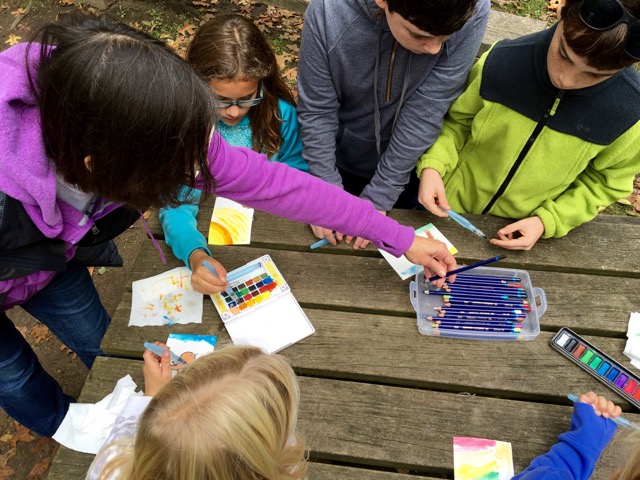
Around noon, I made my way to the Nature Center where I shared space with the park’s annual art fair of local artists and musicians, many of whom I was privileged to meet and discuss art with over the course of the afternoon. A couple of picnic tables in the shade of the building provided a perfect spot to paint and listen to the wide variety of music floating by from the soundstage, from bluegrass to Cuban! Over forty visitors either painted or helped younger family members paint at the tables or in the nature center where displays provided more subject matter. I noted that many trees and blue skies were created on that sunny June Saturday.

In all, I interacted with over 100 park visitors and met many talented creators at the art fair. Nothing beats making art to the sounds of nature and live music. We packed up just before a big thunderstorm that had been building all afternoon hit. It was the perfect ending, I thought, to my return to one of my favorite parks with water in another form falling to the sounds of thunder.

Ending on a High Note at Falls of the Ohio

Last weekend my 2017 Arts in the Parks grant program came to its conclusion high upon bluffs overlooking a unique landscape of barren prehistoric fossil beds in sharp contrast to the sleek skyline of Louisville on the other side of the Ohio River. In the shade of the impressive 16,000 square-foot Interpretive Center showcased by Indiana’s twentieth state park, I enjoyed painting expansive views while meeting all kinds of creative folks visiting that day.

For my morning painting demonstration I found a protected spot on the Interpretive Center’s observation deck where hikers gathered for one of the park’s weekend tours to the fossil beds and beyond. This time of year the dam that runs parallel to the bank lowers water levels enough for visitors to walk over to outer rock beds that are part of an island often submerged by spring floods. I learned that it’s critical for the beds to be consistently flooded to keep from drying out and deteriorating, which seems counterintuitive considering they are made of hard limestone.

For a couple of hours I painted part of the dam built in the 1920s as well as the upper and lower fossil beds created 387 million years ago when corals, sponges, brachiopods and other aquatic life flourished under a shallow tropical sea and were buried in layers of limey sediment that caused them to fossilize. During the glacial retreat of the last Ice Age meltwater scoured the limestone deposits, exposing the Devonian fossil beds and providing a marvelous look at prehistoric life forms preserved in stone for the modern-day visitor.

Unlike many of my demonstrations in the parks, this particular morning I had little use for green paint since the fossil beds resemble more of a moonscape than the usual Indiana scene, even during the autumn droughts which are typical for this area. As predicted the wind began to really pick up before noon and I started to lose the shade provided by the building. I always bring a special plein air umbrella that can be clipped to my easel for shade but couldn’t use it that day unless I wanted my painting setup to sail off the cliffs and over the river like Mary Poppins.

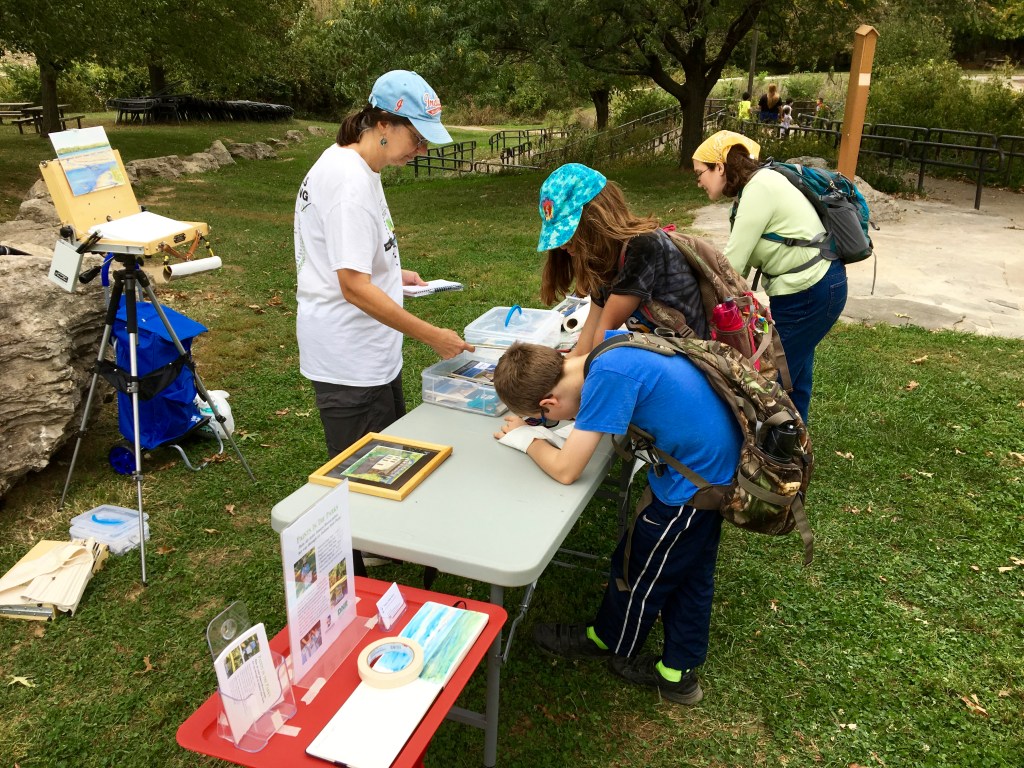
Around noon we found a windbreak for my hands-on painting activity behind some boulders near a welcoming picnic area still in sight of the river and fossil beds, where I engaged with many visitors who were heading toward the interpretive center or coming back from a hike down to the upper fossil beds on an easy path. Overall I engaged with 60 park guests with 14 kids and adults trying out the water brushes and painting supplies.

I also met two Louisville artists who express their creativity in very different ways.  Erik Bendl, otherwise known as World Guy, stopped to talk after collecting driftwood deposited along the river shoreline by high water. He has walked over six thousand miles pushing a large world globe for diabetes awareness and you can read more about his adventures at World Guy.  Albertus Gorman, an artist and art advocate who has an exhibit inside the interpretive center as well as an installation of figurative sculptures near the railroad bridge made from found materials deposited by the river, encourages the public to interact or add to his evolving artwork. Please check out his installations and exhibits at Artist at Exit O Riverblog.

This wraps up another successful grant year at Paints in the Parks. As I prepare my final report, I’m very grateful to the Indiana Arts Commission, the Indiana Department of Natural Resources, and my immediate family for their support and encouragement over these last six months of unpredictable weather and challenging terrain. I especially appreciate all of the park guests I’ve met throughout this program who are open to painting in all kinds of conditions and courageous in their creativity. I will always treasure your willingness to engage with nature through art. It’s what keeps me going as I continue my journey to paint in all of Indiana’s state parks. Thank you for joining me.

Return to Spring Mill

As the dust settles from my third application for another Arts in the Parks grant in 2018, I’ve returned to the studio to avoid an odd post-Labor Day heat wave and prepare for another September visit to Spring Mill. Hard to believe exactly a year has passed since my first painting trip down to Mitchell, Indiana, the birthplace of astronaut Gus Grissom and home to one of Indiana’s best known state parks.

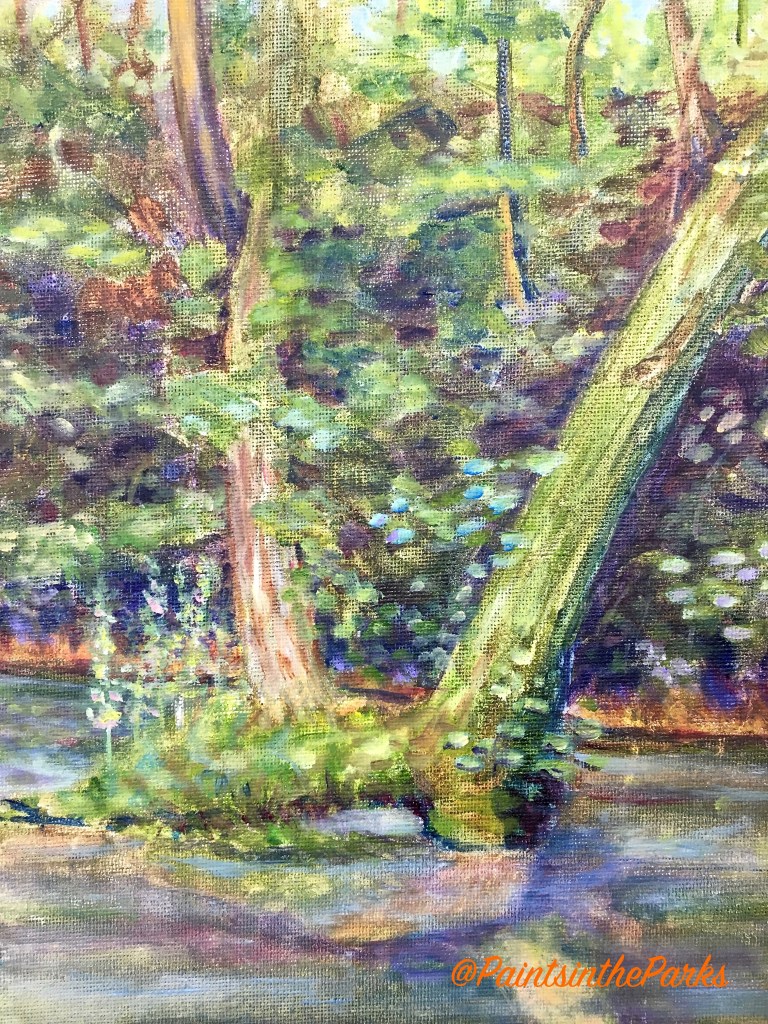
I’ll be bringing with me completed artwork from last year’s visit including an 8″ x 10″ oil painting of the wooded bank near the entrance to Twin Caves. I found a great spot to set up and visit with a crowd of park guests waiting for their boat ride into the caves the morning of my program last year. And I was able to get a good start on this view of fallen logs left to decay, creating a natural environment for all sorts of plant and animal life. Back at home I’ve enjoyed playing with the differences between what is above and below the waterline, helped by the surface refraction of light and shadow.

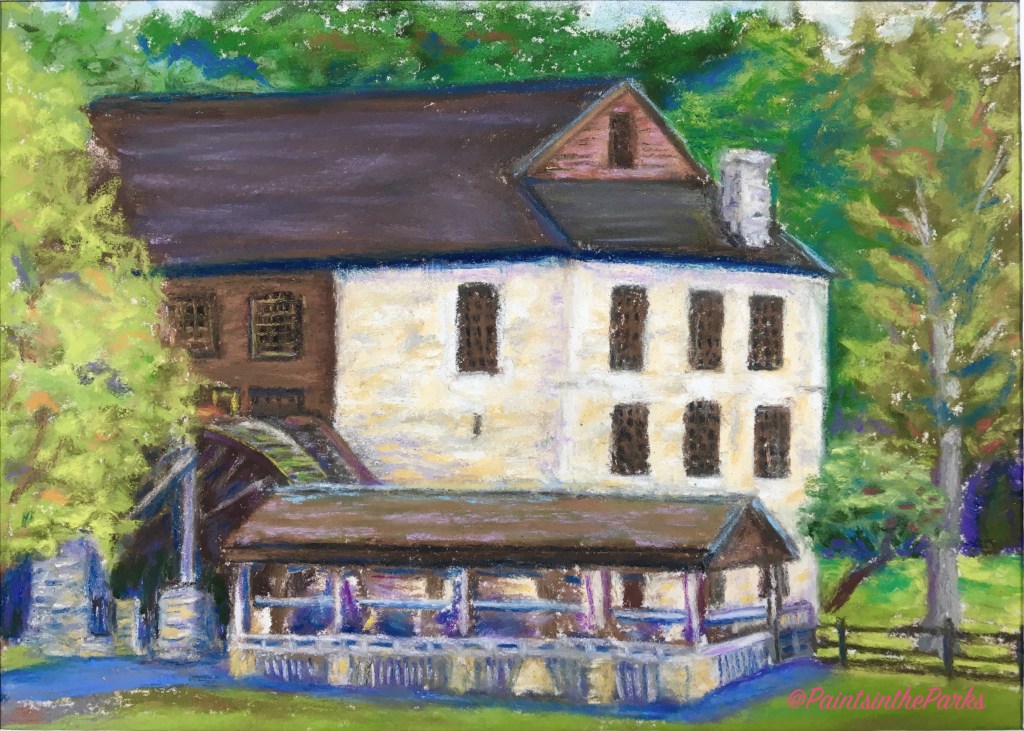
The afternoon rain showers that day forced me to seek shelter in a breezeway between log cabins while working with a pastel of the three-story limestone grist mill that is the centerpiece of Spring Mill’s pioneer village. Since pastels and precipitation don’t mix (unless you want an accidental watercolor) I had to make some creative choices about omitting details such as the unfortunately placed little tree in the foreground. No matter, I was able to take some better photos when the rain ended that helped me fill in details later and finish this 5″ x 7″ pastel on sanded paper in the studio.

A year later I’m preparing to paint the grist mill again, this time with oils. I confess that I’m not particularly confident about my skills in rendering buildings, especially using brushes since I have much more experience with drawing. For me trees and organic natural forms are much more forgiving than linear edges and the dreaded two-point perspective. I prefer to eyeball and claim near-sighted impressionism as my inspiration.

Last year I promised to return to Spring Mill in honor of the bicentennial of the grist mill begun in 1817 with several revisions throughout the years. I particularly admire the stone pillars of the flume that transports water to power the mill wheel from cave springs up the hill. Perhaps I’ll find a shady spot underneath those pillars since, unlike last year, the day promises to be nothing but sun in the upper 80s. But I’m grateful to be able to take these challenges in stride because I’m aware that life, as in painting, is made more interesting in its contrasts.

Harvey and the Hay Press at O’Bannon Woods

Seems like each year that I offer my state park program there’s always one event where I need to make the difficult decision of whether to go ahead on the scheduled date (usually a Saturday) or wait until the next day (usually a Sunday). Last year Indiana Dunes presented this dilemma although I’d already booked a hotel just in case. This year the remnants of Hurricane Harvey threw a very soggy wrench into my plans forcing me to decide whether to risk a five-hour roundtrip drive that might have been in vain.

Based on the weather forecasters’ best guesses and my previous experience with a hurricane’s notorious unpredictability, I decided to postpone my Labor Day Saturday event at O’Bannon Woods State Park until Sunday. And even when Harvey’s rain did end on Saturday morning in southern Indiana after a 24-hour drenching, the day actually became colder with a damp north wind. Sunday, on the other hand, couldn’t have been more beautiful as often happens after a hurricane passes through and I was assured by staff and visitors that I’d made the right choice.

Located west of Louisville in extreme south central Indiana along the Ohio River, the 2,294-acre park was originally established in 1980 as a recreational area called Wyandotte Woods and renamed in honor of Indiana’s late Governor Frank O’Bannon and his family in 2004. This secluded and beautiful park is nestled within one of Indiana’s largest state forests, the 24,000-acre Harrison-Crawford which is a timber source that also offers canoeing, hiking, hunting, fishing, birding and swimming.

I spent my day at the charming Hickory Hollow Nature Center which houses one of the best nature and wildlife collections and exhibits of any park I’ve visited so far. Directly behind the nature center visitors will find an outdoor wetlands pond, living-history demonstrations in a pioneer farmstead, and a restored historically accurate 1850s hay press and barn with its own museum. On special weekends throughout the year demonstrations of the hay press using one of two oxen housed at the farmstead are offered, as well as numerous interactive demonstrations that include tomahawk throwing, archery, rope making, blacksmithing, yarn spinning, log sawing and even panning for gold.

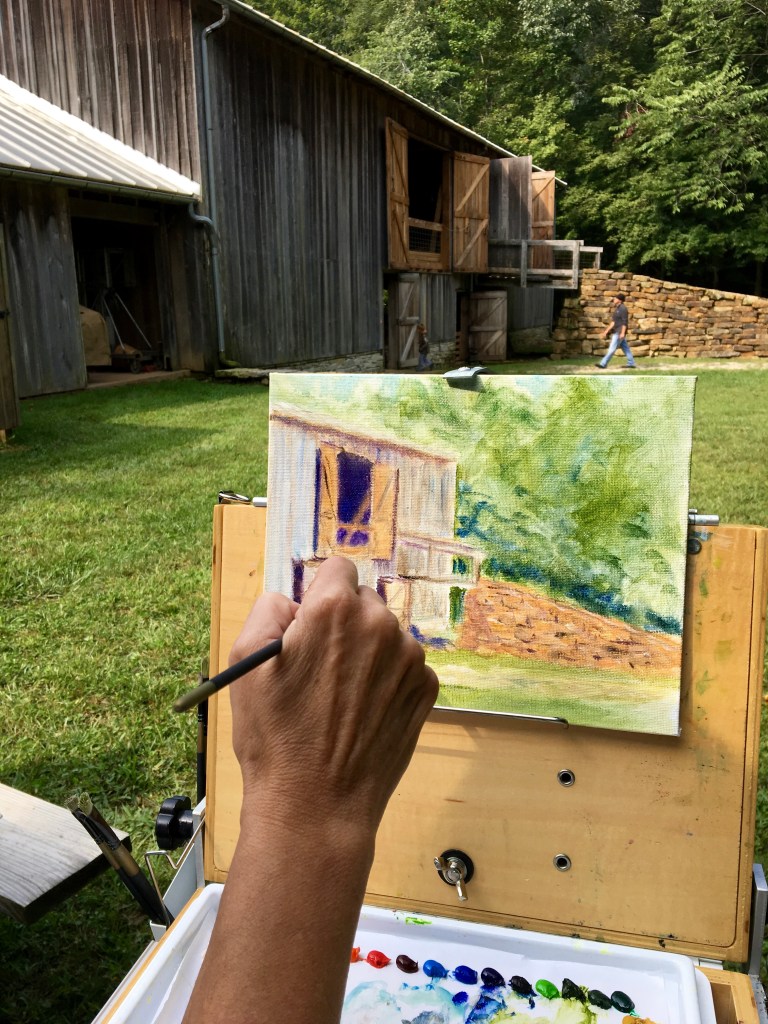
In the morning I painted the hay press barn where the beautifully crafted stonework on the ramp leading up to the main barn doors caught my eye. Situated along the main path to the pioneer farmstead and all the activities, I had plenty of chances to engage with not only park visitors but also the friendly volunteers who spend many hours sharing their talents and expertise for the love of the park and what they do. In fact, my husband and I were welcomed with hot coffee and blueberry pancakes fresh off a cast iron griddle over an open fire as soon as we arrived. You can’t beat that!

Around noon I set up my painting activity in the sunny courtyard between the nature center and the barn where the hay press demonstration takes place. Almost immediately visitors were lining up to try out my water brushes and paint supplies. Ann, one of the volunteers from the pioneer farmstead, joined me to offer frames for completed artwork as part of their children’s craft. The paper frames glued to regular copy paper could be decorated with crayons and stickers. Some participants even used watercolor paint! The frames really added to the artistic experience and I was very grateful for Ann’s idea that could be a great creative option in the future.

Even during the hay press demonstration with 400 visitors in attendance there were still plenty of artists outside painting on the convenient picnic tables while the sun shone, the birds called and butterflies landed on flowers in the wetlands pond. In total, O’Bannon Woods broke all the Paints in the Parks records so far with over 200 interactions and 85 painting participants! It was so gratifying to watch entire families painting at picnic tables with multi-generations peacefully sharing paints and water brushes, chatting and laughing. Several parents remarked on how easy and natural this activity is but how seldom it seems to happen at home.

Since I ran out of almost all my supplies after such a tremendous turnout, I was able to wrap up with enough time to tour the farmstead myself, interact with the artisans who were demonstrating their own skills, and admire the many forms of creativity and art offered. In fact, the hay press itself is a marvelous piece of art in my opinion with its hand-carved wood and practical beauty. Of course, I need to return one of these days so I can see this art put into action!

River and Ruins at Charlestown

The beautiful August day I spent at Charlestown State Park on the Ohio River near Louisville was one for the record books. While enjoying a flawless blue sky and crisp breeze I painted barges on the river, discovered ruins on a mysterious island, and talked to many visitors who couldn’t believe that this was August with such fall-like weather.

Established in 1996 as one of the newest state parks, Charlestown’s 5,000-acre parcel is bordered by the Ohio which is fed by Fourteenmile Creek that runs through the park, one of the oldest unglaciated stream valleys in Indiana. Mostly open farmland or pasture at the turn of the century, much of the park’s reforestation occurred under the resource management of the US Army which operated an ammunition plant on the property from 1940 to 1995.

For my morning demonstration I set up my easel for oils at one of two overlooks along the Ohio near the park’s boat landing where I attempted to paint my first barge as they slowly came into view around a distant bend in the river. While engaging in some great conversations about art and life with visitors who stopped by to experience the river, we saw fish nibbling at the rocky edges and plenty of herons soaring high in an empty blue sky. No chance to practice painting clouds that day.

After lunch I headed down a very steeply graded road across Fourteenmile Creek to Rose Island, the site of a 1920s amusement park that was heavily damaged in the infamous 1937 flood that also affected Louisville downstream. Luckily the DNR van was able to drive me and all my supplies to my painting site across an old 1913 truss-style bridge relocated to provide access to the island. Only a few concrete and stone structures remain of the amusement park that welcomed 135,000 guests a year, offering rental cottages along the river as well as a hotel, swimming pool, dance hall, rollercoaster and zoo.

I positioned my easel at the entrance to the Walkway of Roses where climbing vines once covered the three arches that can still be seen near the foundation of the dance hall. The arches were also lit back in the 1920s providing a romantic path on those happy summer evenings before the Depression and World War II. Now only the stone and metal arches remain with young trees growing in between the posts and nature doing her best to hide the island’s secrets of the past. The purposes to some of the remnants remain unknown and archaeological digs on the island have yielded artifacts from both the amusement park and indigenous people who lived in the area.

My demonstration along the trail provided a stopping point for the Rose Island Guided History tour led by interpretive naturalist Jeremy Beavins, where I talked to over twenty participants about my program and the supplies I’d brought that day. Later that evening some visitors from the tour group met me at one of the spacious picnic shelters for my hands-on watercolor activity. Painting in the golden rays of the setting sun while listening to song birds was the perfect ending to a wonderful day at Charlestown where I interacted with over 50 visitors overall.

Many thanks to the DNR staff who promoted my program and made it easy to experience the best of Charlestown. I hope to return soon so I can go on the complete Rose Island guided tour and hear the rest story.


A Perfect Day at Potato Creek

Despite the ominous weather forecast I couldn’t have ordered up a more perfect day at Potato Creek State Park, located just south of South Bend near North Liberty, Indiana. Named after the potato-like roots that were once collected by Native Americans along the creek banks, Potato Creek feeds into Worster Lake, a man-made reservoir begun in the 1930s by local conservationist Darcey Worster that covers 327 acres of the park’s six square miles. Dedicated in 1977, the park’s management programs are focused on restoring and maintaining Potato Creek’s unique natural areas and wetlands.

I began my visit to Potato Creek on Trail 3 overlooking a marshy inlet of Worster Lake directly across from the swimming beach. While setting up my easel to the bass tones of bullfrogs I noted the lushness in the vegetation and trees that contrasted so well with the sculptural starkness of the decaying trunks and logs. I decided to try out an 8 x 10-inch clay panel using my water-mixable oils for the morning demonstration and engaged with six visitors including one who arrived with art supplies prepared to join me in capturing the scene.  It was a pleasure to have some artistic company and discover the same scenery through another’s interpretation.

Around noon it was time to pack up and head toward the nature center on the other side of Worster Lake which took us through some meadows and prairie decked out in summer’s full glory. I was impressed with the size of this state park and the variety of recreational activities that its topography allows. I was informed that this particular park is a frequent location for triathlons and other outdoor challenges. As well as an extensive campground, the park offers facilities and areas for hiking, picnicking, swimming, boating, horseback riding and bike riding.

As the good weather held I was able to set up the hands-on watercolor activity outside in front of the nature center where over 100 park visitors stopped by my art table and a record 66 kids and adults tried out my water brushes, crayons, colored pencils and Micron pens. Luckily I didn’t run out of supplies while people spread out in all directions including some who took advantage of the amazing exhibits inside the nature center to use as painting subjects and came back with their own renditions of turtles, owls, reptiles and even an osprey!

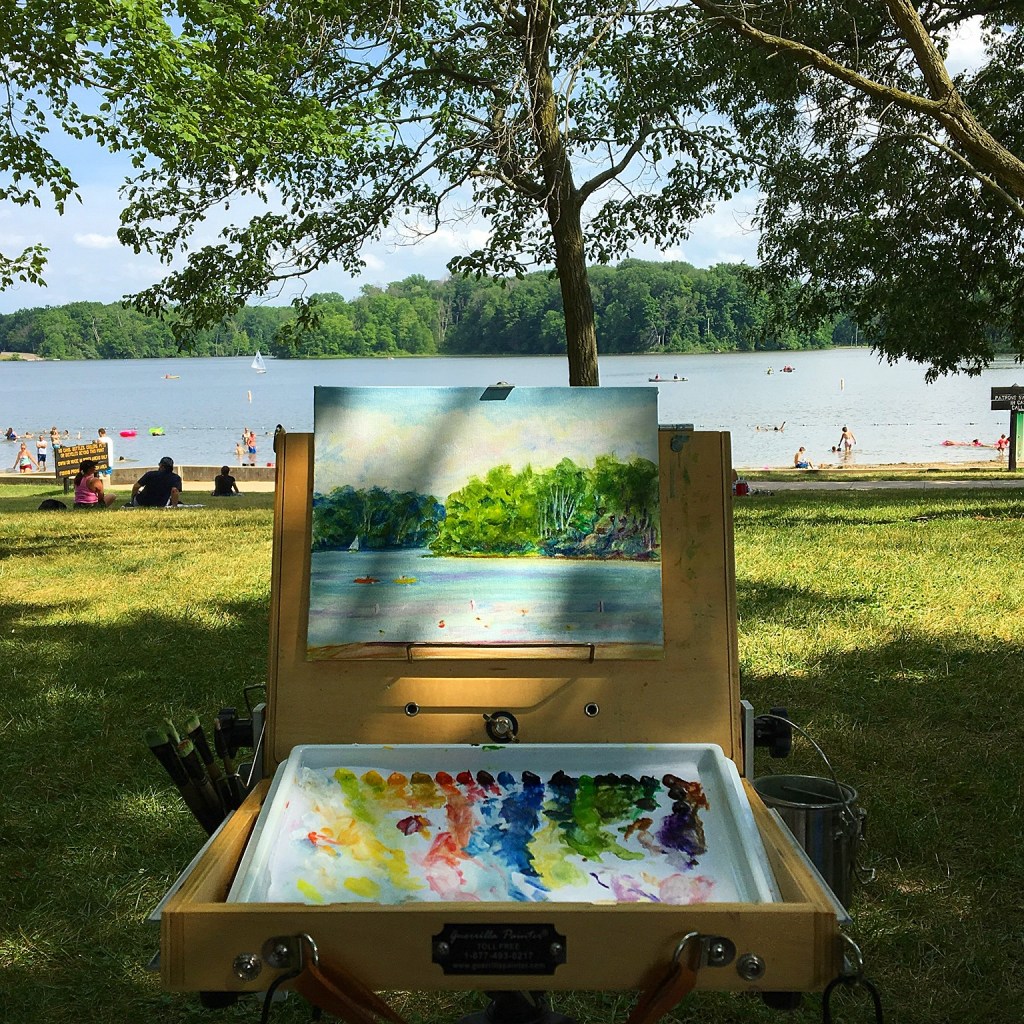
Several of the artists who visited me in the morning stopped by to try out my painting materials and a homeschool family that shared my interests in art followed me to my next stop for the afternoon at the swimming beach. We settled down in a shady spot on the lawn under the trees overlooking the beach and had a marvelous discussion about various forms of art and techniques. Amazingly the predicted violent thunderstorms stayed away as I visited with 27 park guests who were out enjoying the swimming, volleyball, hiking and bike trails. I used a regular canvas panel with oils to capture a beautiful scene on the lake complete with a sailboat, kayaks and the bright spots of color from swimsuits and beach balls.

As we headed south in the light of a gorgeous sunset at the end of the day I was very grateful that the weather forecasters were wrong for once, and I know that the nearly 150 park visitors I met that day were, too. As always, many thanks to the DNR staff who advertised and made me feel welcome, and the Indiana Arts Commission for helping to make painting in the parks possible.

Hunting for Harmonie

Located in the very southern “toe” of Indiana near the historic utopian community at New Harmony, Harmonie State Park was my first stop in this year’s quest to visit six of the most recent additions to Indiana’s park system. Established in 1966, Harmonie’s 3,465 acres border Illinois and the Wabash River on its way to a rendezvous with the Ohio. With its river views, olympic-size pool, multiple picnic areas and 200-site campground, Harmonie provides plenty of outdoor entertainment.

Due to heavy rains and flooding my original date for visiting had to be pushed back a week until the flood waters receded. The park had only been open for two days when I arrived on Saturday morning, May 20th during a very active thunderstorm. Luckily the storm moved through quickly and I was able to venture down to the dock of the Little Harmonie Pond, taking only my watercolor kit, a sketchbook and my camp chair just in case there was more rain on the way.

I quickly started working on a view of the pond including one of the beautiful blue benches that reflected so well in the still water. Before long a group of boy scouts and their leaders from nearby Evansville appeared with fishing gear and poles to try their luck at the pond. I enjoyed watching the young fishermen cast their lines and listened to their friendly banter while waiting for a bite. I was able to get a good start on the painting by the time I was scheduled to head over to the Nature Center.

The sun was just beginning to peek out while I set up for the watercolor painting activity under some shade trees next to the building. Facing the campgrounds, I was able to entice young and old alike to grab a paint set, water brush and an assortment of Inktense pencils, Micron pens and (new this year) watercolor crayons. Visitors were able to sit at several brand-new picnic tables nearby and spend a leisurely hour or so painting and chatting with friends and family while listening to the sounds of nature surrounding them. Around fifteen children and grownups stopped by to paint and let me take their photos while proudly displaying their artwork.

For the afternoon demonstration I set up along the Wabash River which was still very high and had overflowed its banks just a few days earlier. In fact the spot I’d chosen to place my easel had clearly been underwater at some point. But with a good coating of bug spray I was blocking out color in no time under some lovely shade trees overlooking a scenic stretch of the river.

Just in time too because I was placed at the river for a reason. For the first time ever I was actually part of a photo scavenger hunt. Participants had to find the artist and take a picture with me and my painting as one of a long list of clues. Not only was this an excellent way to see the park and learn about all the features you might otherwise miss, but I had the opportunity to interact with visitors and show them some plein air painting in action. Scavenger hunters had a chance to compare what I was painting and note my use of colors you wouldn’t expect. For instance instead of brown or blue water, the surface of the river had a pink glow in the afternoon light that day and everyone could really see that.

All totaled I visited with about 55 guests for my first park, many of them braving the damp conditions to camp that weekend. Considering that half the state had canceled all kinds of plans for the weekend because of the wet weather, I call that a success!

Painting Matters at Mounds

With one successful park program under my belt last May I began June’s visit to Mounds State Park near Anderson, Indiana, with a little more confidence, boosted even more by the two lovely ladies who were waiting to draw with me that morning. The park naturalist had done a great job advertising the Paints in the Parks event and they had brought along pencils and paper to capture the Great Mound with me for a pleasant few hours.

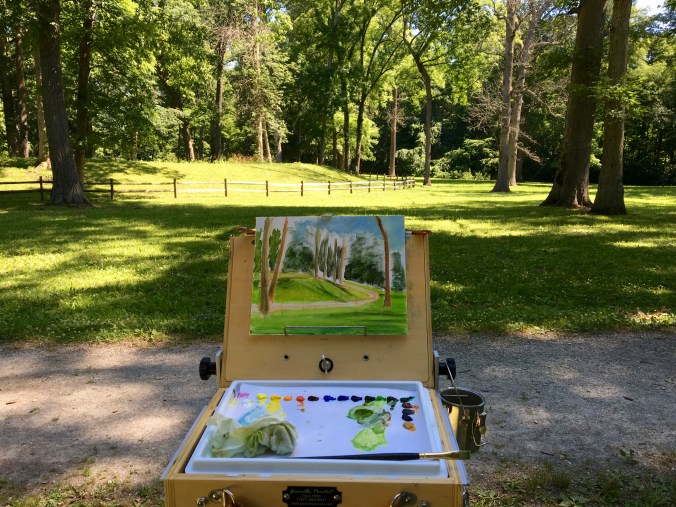
The weather was sunny and mild that day, maybe the best of all the park visits last year. I found a good spot with a little shade near the trail leading to the Great Mound’s entrance where I could talk to visitors strolling by as I took advantage of the strong morning light and shadows. Faced with the largest of the earthworks created by a group of prehistoric people I could only capture a portion of the mound, reenforcing the plein air painter’s need for framing and omission in the composition of a painting.

I’m pleased to report that the Great Mound’s distinctive shape topped by tall trees and surrounded by a rustic rail fence prompted park guests during subsequent events to immediately recognize the subject whenever they saw this painting on display. Considering that these remarkable landmarks had to survive the construction of an amusement park on top of them in the early 20th Century, I’m very lucky to still be able to capture the spirit of this sacred site.

The above glimpse of my palette gives me the perfect opportunity to introduce my choice of paint and colors. A friend who is an accomplished art teacher and oil painter gave me a beginner box of Artisan Water Mixable Oils made by Winsor & Newton. Since I began my training as an acrylic painter and knew nothing about oils, I was eager to try an alternative to the traditional thinners and mixes, and use water for mixing and clean up. I supplemented with tubes of Duo Aqua Oil by Holbein, which are very creamy and easy to use. My color palette includes the usual basics like Lemon Yellow, Cadmium Yellow, Cadmium Red, Alizarin Crimson, Cerulean Blue, Ultramarine Blue, Burnt Sienna, Yellow Ochre and Titanium White. But I also like to include Dioxazine Violet, Raw Umber, Cadmium Orange, Cobalt Blue and Prussian Blue.

And then there are the greens. Because you need to work fast in plein air, I prefer to go the “lazy” route of pre-mixed greens (suddenly I have a hankering for salad) which include Sap Green, Light Cadmium Green, Phthalo Green and Terre Verte. As you can see, that makes for quite a few colors lined up so it’s helpful to have them already squeezed out before you head out to paint. I use a covered palette with a piece of palette paper cut to fit in the bottom for easy cleanup. This arrangement has worked for me but there’s still some waste despite the small amounts. In 2017 I hope to try a more limited palette that will control the relationship between color groups and emphasize values better.

Around lunchtime I packed up the oils and moved down the trail to the Bronnenberg house, pioneer residence to one of the first settlers in the area. I will admit that buildings, straight edges and perspective are not my forte; give me a twisted tree trunk or winding stone-strewn creek any day. With that in mind I had already gotten a good start on a pastel of the historic site in my home studio based on photos from a previous visit. I knew the tiny details of countless mullioned window panes would be my undoing on a rickety easel along the breezy and uneven trail. Some work is best done flat on a table.

What was left was mostly what I enjoy, like filling in plantings and the rail fence in the front yard. My preparation paid off as I continued to greet and chat with a large group on a nature hike as well as folks touring the house. I even gave a short video interview for a reporter from a local newspaper as I nervously dabbed at my picture with soft pastels. One of my friends from Indianapolis joined me to paint with her watercolors. The sun continued to shine but wasn’t unbearably hot.

After a couple of hours that went by too quickly I was ready to pack up and head for the Nature Center to offer my watercolor painting activity and participate in a big birthday party with an enormous sheet cake to help celebrate Indiana’s Bicentennial and the state parks’ Centennial.  More next time about my pastel palette and pastel paper preparation. Until then, help yourself to some cake!

Falling Water

Painting at a safe distance with pastels on an 8 x 10" Ampersand pastelboard.
Painting at a safe distance with pastels on an 8 x 10″ Ampersand pastelboard.

During my painting events in state parks this year visitors kept recommending that I visit Cataract Falls State Recreational Area, an easy drive from Indianapolis on I-70 near Cloverdale, Indiana. Whenever I mentioned my love of painting water in its many forms, the answer was often, “Oh then you need to paint Cataract Falls. They’re the best in Indiana!” After my visit earlier this month on a gorgeous Saturday afternoon I can tell you that those claims aren’t exaggerated.

A robust Mill Creek feeds the upper and lower sets of waterfalls which run over two ridges of pre-glacial bedrock, boasting the greatest volume of water (and sound) of any waterfall in the state. Both upper and lower falls provide plenty of good views for painting but I settled on a spot at the edge of the ravine below the upper falls apart from the viewing platforms and steady stream of foot traffic. There is also a historic red covered bridge that crosses the creek nearby featuring a unique lattice-pattern truss system. I hope to paint it and the lower falls when I return.

The irony is that my family and I used to live just up the road years ago, and never knew about this hidden treasure. Now that we have been captured by its charms we will definitely come back to Cataract Falls in the future.

Praise for Pokagon

I couldn’t have asked for a better finale to cap off my 2016 Arts in the Parks grant than my final program at Pokagon State Park near Angola, Indiana. Located in Indiana’s lake country at the very northeast corner of the state, Pokagon borders two natural lakes and was named for the last notable leaders of the Potawatomi native people who sold one million acres to the federal government (including the area that became Chicago) for the price of three cents an acre.

The park offers two beaches, 12 miles of trails, wooded hills, wetlands, open meadows and even a toboggan run built by the CCC in the 1930s. The lakes as well as the marshes, fens, swamps, pine groves and other unique ecotypes typical of more northern regions were created by one of the last glaciers to cover Indiana ten thousand years ago. Land that was farmed decades ago has been allowed to return to its natural state and the nearby Trine recreational area added in 2007 complements Pokagon as part of local and statewide efforts in land and water preservation.

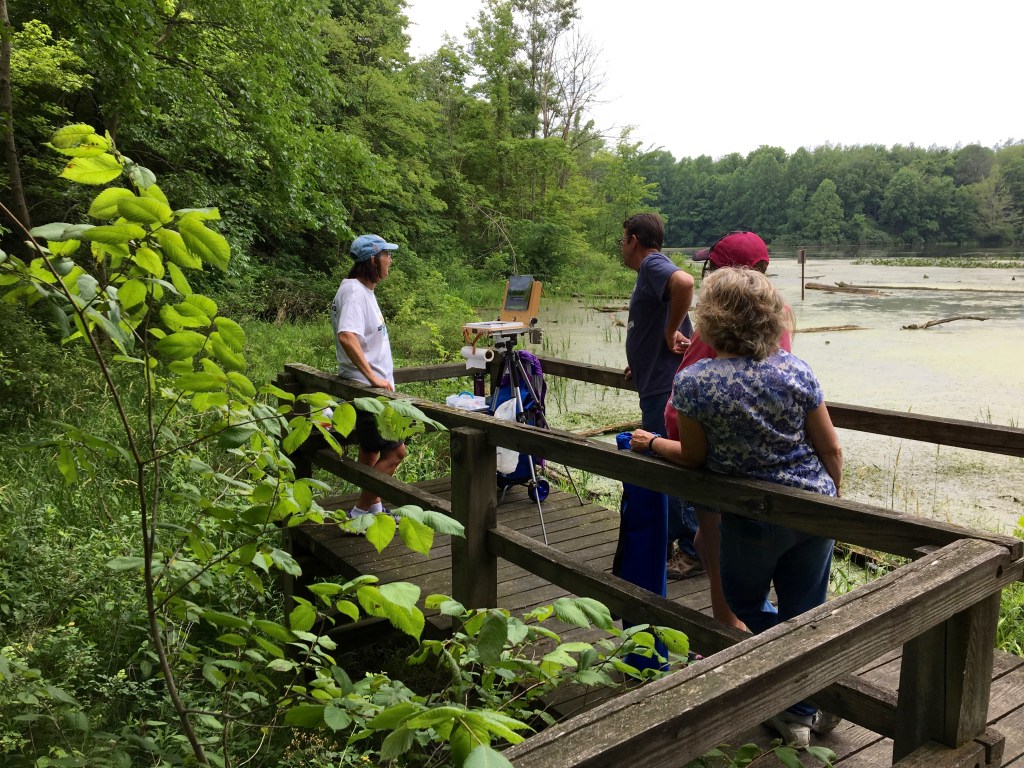
I spent a chilly but pleasant morning painting on the pier at Lake Lonidaw, a kettle-hole lake formed when sunken blocks of ice broke away as the glacier melted. The mat of reedy vegetation along the edges fools you into thinking this is a stagnate pond when in reality this constantly moving body of water drops off to a depth of 30 feet. Armed with a cup of hot coffee and plenty of duct tape to keep my supplies from flying into the lake, I made good progress capturing fall foliage in oil, saw a great blue heron glide by, heard plenty of red-winged blackbirds, and engaged with a morning tour group led by a Pokagon interpretive naturalist.

At noon in a wonderful gathering area full of comfortable tables and benches outside the nature center, I received a tremendous response to my watercolor painting activity with over 40 kids and adults trying out my watercolor kits, water brushes, Inktense watercolor pencils and Micron drawing pens with ink that doesn’t run when you paint over it. By far the largest turnout of all the park events, I’m pleased to say that every piece of watercolor paper I brought was used and some wonderful connections were made including a family who just happened to stop by on their way to Ohio to see their son in college, a little girl who spent two hours on a beautiful tree inspired by something in my sketchbook, and a student from an Indianapolis art institute who is adding her watercolor painting to a school art project focusing on geography.

I finished the day at the Potawatomi Inn beach on Lake James with the sun casting interesting shadows on the little boat house I was painting and the brisk fall breeze spurring on the little white-capped waves that raced to shore. I had some great leisurely conversations with curious visitors and interested painters about my painting subjects, equipment and set up. All told, I engaged with over 100 park visitors during my final painting event with the added treat of spending a long weekend at the beautiful Potawatomi Inn built in 1927. Many thanks to DNR naturalist Marie Laudeman and the rest of the park and inn staff for such a successful and pleasant visit; and to the Indiana Department of Natural Resources, the Indiana Arts Commission and the Indiana Bicentennial Commission for their support throughout my 2016 Arts in the Parks grant.

My painting programs may be completed for the year but I’ll still be painting outside whenever there’s a good day this fall (and maybe even winter) while I continue to finish the paintings I began at all the wonderful state parks I had the privilege to visit this year. As a way to brighten up bleak winter days I’ll also be working on new paintings inspired by the wildflowers I photographed on my walks along the trails. So, stay tuned for regular updates to Paints in the Parks and thanks for following along.