

My visit to Indiana’s newest state park this month challenged me to try out alternative equipment in new locations that differed from my typical schedule. Prophetstown’s unique blend of prairie, wetland and woods honors the memory of important Native American history while providing the perfect setting for painting and interaction. As if that wasn’t enough, this new state park also features several picnic areas, bike trails, an aquatic center, extensive campground and a 1920s small-scale working farm.
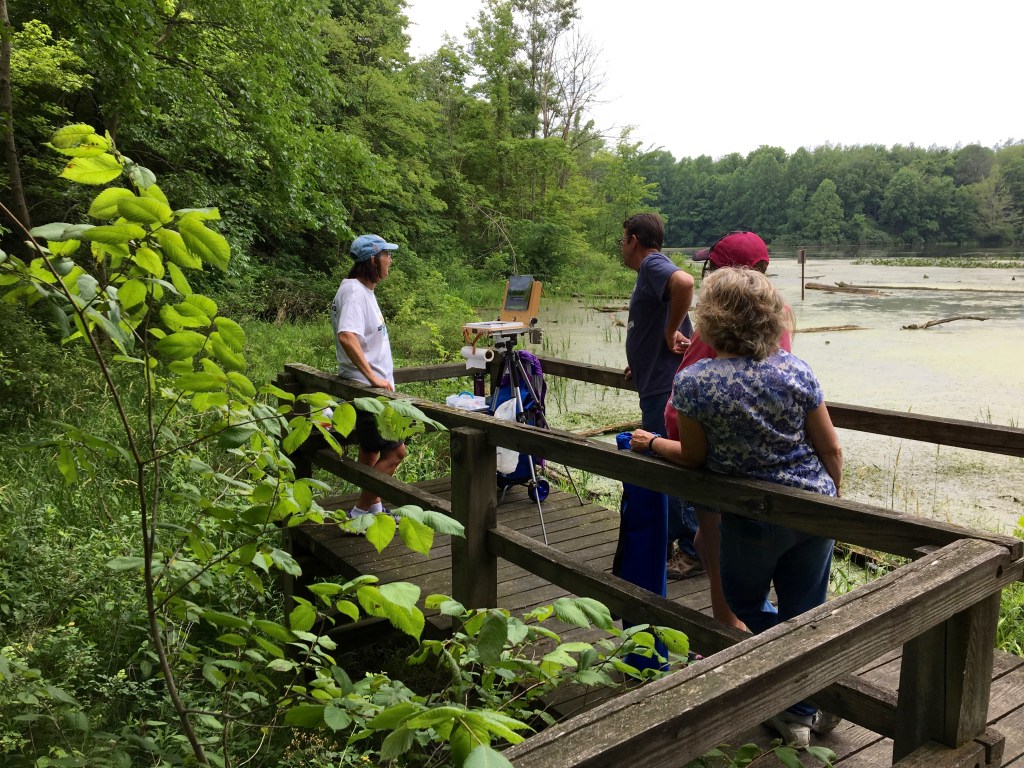
Established in 2004, the park sits at the edge of what was originally a tallgrass prairie with areas of open oak woodlands. Glaciers passed across the park at least three times, creating the landscape that I was lucky to paint during my visit. My morning painting demonstration was located at an observation deck overlooking the wetlands and floodplain where the Tippecanoe River meets the Wabash. Harrison Creek flows close to the platform from a pond and fen created by those same glaciers and was running high that morning from all the recent rains.
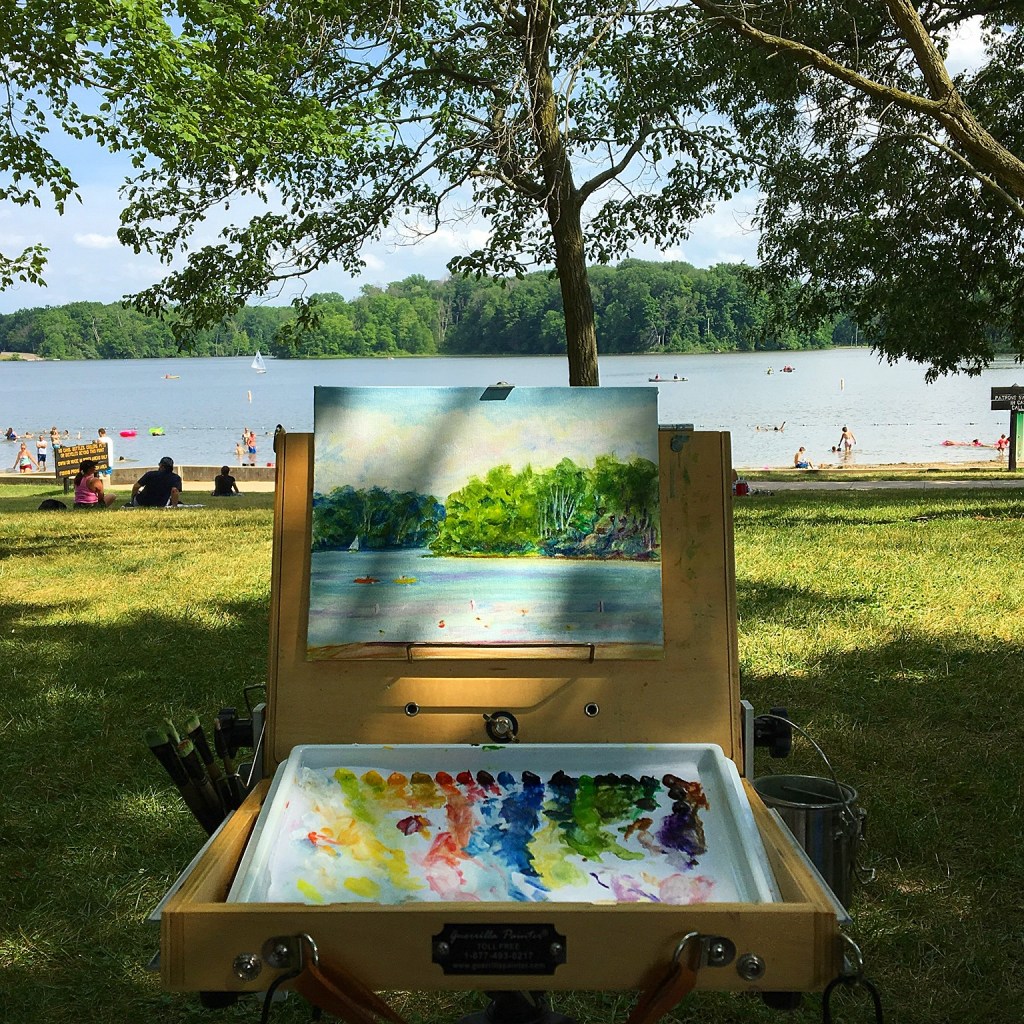
For the first time since I began painting in the parks I arrived without the tripod that attaches to my paintbox, reenforcing the need for a packing list (that I have already written upon return). Luckily I was able to use my 4-foot folding table set to its highest height, and could spread out the paintbrushes, paint palette and my water container on a stable surface. When I had to pack up and retreat to the car for a brief rain shower, I was able to leave the table set up since it is waterproof. I returned to continue work on the oil painting I’d started while talking to nine visitors and observed many shorebirds and waterfowl including great blue herons and kingfishers.
After lunch I set up another painting demonstration under the shade shelter at the Native American Village located in the restored prairie near the visitors center. The collection of structures that includes a medicine lodge, council house and chief’s cabin replicates a settlement established by Tecumseh, who was Shawnee, and his brother Tenskwatawa (The Prophet) in 1808 to stop the European westward settlement.
Forced from his homelands in Ohio, Tecumseh formed an alliance with the Ojibwe, Delaware, Kickapoo, Miami, Ottawa, Potawatomi, Shawnee, Wea, Wyandot, Winnebago, Fox, Sac, Creek and Menominee, hoping to repel the advance of European settlement. They congregated at Prophetstown and heard The Prophet speak. While Tecumseh was away recruiting more support, The Prophet decided to strike first in the early morning hours of Nov. 7, 1811 where he engaged William Henry Harrison, governor of the Indiana Territory, and his 1,200 troops in the Battle of Tippecanoe that lasted two hours. Defeated, the villagers retreated to Wildcat Creek while Harrison’s men burned Prophetstown to the ground.
Pine branches layering the roof of the shelter provided marvelous shade while I began a pastel of the granary and talked to 13 visitors that hot afternoon. Two children and two adults tried out my water brushes, paints, pencils and crayons along with two members of the DNR staff. The naturalists also provided pokeweed berry juice that was used as a dye by the indigenous people and became an excellent paint for my painting activity. I was amazed by its color and consistency and thoroughly appreciated how the poke berries blended in perfectly with the watercolor paints.
After an early dinner at a local restaurant in the town of Battle Ground and a tour of the battlefield along Burnett’s Creek where The Prophet’s warriors met Harrison’s troops, I returned to Prophetstown for an evening painting program at the campground next to the shower house. The head interpretive naturalist, Angie Manuel, not only introduced me as part of Indiana’s Arts in the Parks and Historic Sites with a brief background of the grant program, she brought lots of natural objects and artifacts found on the park grounds for participants to paint.
We had a great turnout with 30 campers showing up for the presentation and 26 kids and adults participating in the painting activity. All told, I engaged with nearly 50 people throughout the day at Prophetstown and learned so much myself about the history of the park and the culture of the Native Americans who maintained the prairie landscape for hunting and gathering. And if you visit this beautiful park be sure to stop by the stone circle located in the northeast corner of the park near the observation deck and basketball court which includes a number of stones bearing plaques representing the known Native American tribes that lived at Prophetstown.
 Paints in the Parks