Drama at the Dunes

My good luck with weather finally came to an end at the fourth park on my Paints in the Parks schedule this year. Saturday began with ominous forecasts and strong winds in advance of a cold front bringing severe storms to the Chicago area first and then to Indiana Dunes State Park, located about 50 miles east and surrounded by the Indiana Dunes National Lakeshore. Fortunately I usually book Sundays as possible rain dates and in this case I was so glad I did!

My first stop Sunday morning under dramatic skies was the bird observation platform with views of the Dunes Prairie Nature Preserve and some of the three miles of beach along Lake Michigan’s southern shore. I enjoyed capturing shifting cloud formations that determined what colors appeared on the lake’s surface. A stiff northern breeze even worked up some whitecaps for me to practice painting although the rough water and high tide that day ruled out swimming, much to the Sunday beachgoers’ disappointment.

Midday was spent at the Nature Center where nature hikes, beach yoga, shipwreck stories and a bird watercolor workshop were among the many activities featured at this busy state park that encompasses over 1500 acres of beach, sand dunes, black oak forest, marsh and wooded wetlands. A steady stream of adults and children stopped by my table to try out the water brushes and special Inktense watercolor pencils I brought along for an outdoor watercolor activity. Over 20 brave individuals took up my challenge to paint in the park and some even let me take their picture showing off their wonderful works of art.

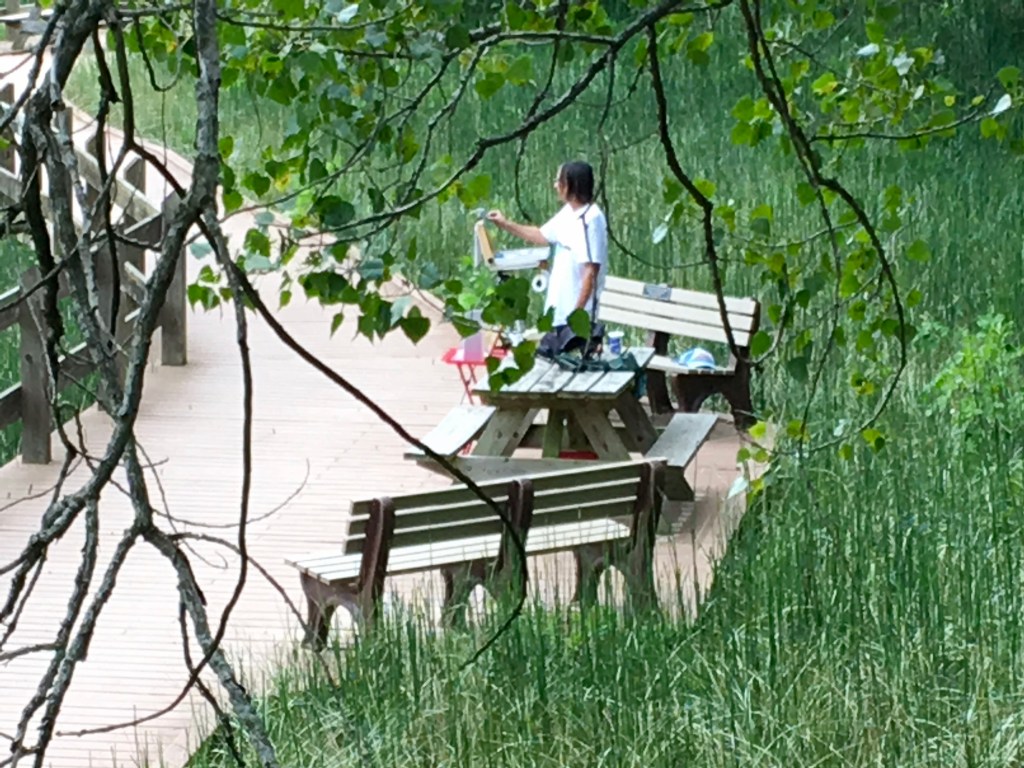
I finished off the afternoon working with pastels on pastel board along the boardwalk overlooking a button-bush marsh connecting the beach access to a very busy campground. Overall I interacted with 70 visitors to the park, many from the Chicago area. I particularly enjoyed meeting quite a few college students relaxing at the Dunes before heading back to school.

While I made good progress on the two works I began that day, I need to come back and paint the other unique habitats and diverse landscapes preserved in this state park established in 1925. In fact the father of ecology, Henry Cowles, conducted landmark research on the flora and fauna here putting Indiana Dunes on the map as “the birthplace of ecology.” I hope to return soon prepared to make the steep climb up some of those “moving” dunes for that dramatic view that’s well worth the effort.

The Mists of Turkey Run

July’s painting event at Turkey Run State Park featured all the best of a summer day: beautiful weather, an afternoon thunderstorm, an ice-cream social, and a mystical time inside those famous hollows used by pioneers to corral wild turkeys for hunting, hence the name for one of the busiest state parks in Indiana.

The second park to be established in Indiana’s state park system, Turkey Run’s sandstone bedrock was carved into canyons and formations by the glaciers that brought boulders and plant life only seen in northern areas of Michigan and Canada. The hemlock groves and canyon ecosystems are found nowhere else in Indiana. This park is also the final resting spot for Col. Richard Lieber, father of Indiana State Parks, and home to the 19th Century Lusk Home, the Lieber Cabin built with virgin timber in the 1840s, and the Log Church built in 1871. There is also a covered bridge over Sugar Creek and a suspension bridge that leads to the sandstone canyons and rugged trails.

I set up at the suspension bridge in the morning, and used pastels to capture the steps and concrete base with a glimpse of the creek as many visitors strolled by on a beautiful Sunday. I had some great conversations about what I was doing throughout the morning, meeting many who were creative artists in their own way including a blacksmith and a quilter. I saw over 140 visitors for the day, my most successful event yet.

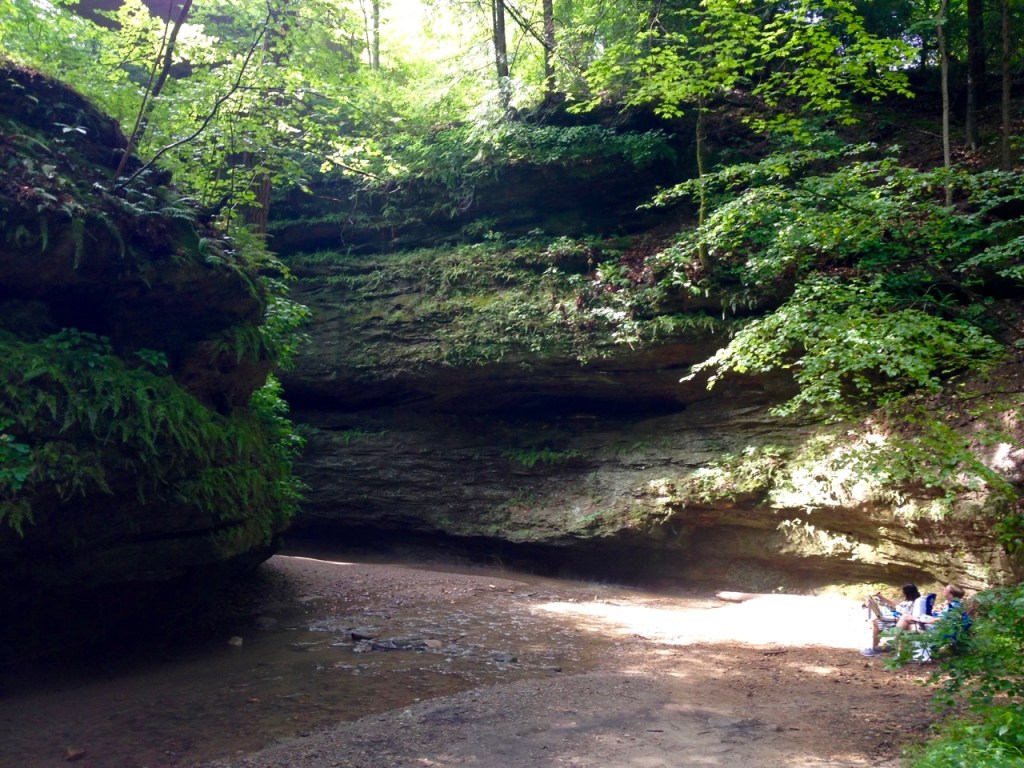
My watercolor activity at the Nature Center around noon was also a big hit with over 25 kids and adults trying out water brushes and field kits despite the afternoon thunderstorm that cut my time short. After a brief stop for the 100th birthday celebration with cake and ice cream at the Inn, I descended with only my paintbox and a camp chair to the entrance of Turkey Run Hollow where the cool creek water and saturated air from the thunderstorm met to form the most beautiful mists and light rays that cut through the dampness. Hikers paused to chat by my chair before attempting the trail’s precarious water crossing.

There’s so much to see at Turkey Run that I’m sure I’ll return soon to paint its wonderful covered bridge or the waterfalls in hidden canyons full of dense green ferns and moss. Until then, I’ll treasure the memories of a perfect summer day and the glimpses of a mystical world brought by glaciers.

Magic at Mounds

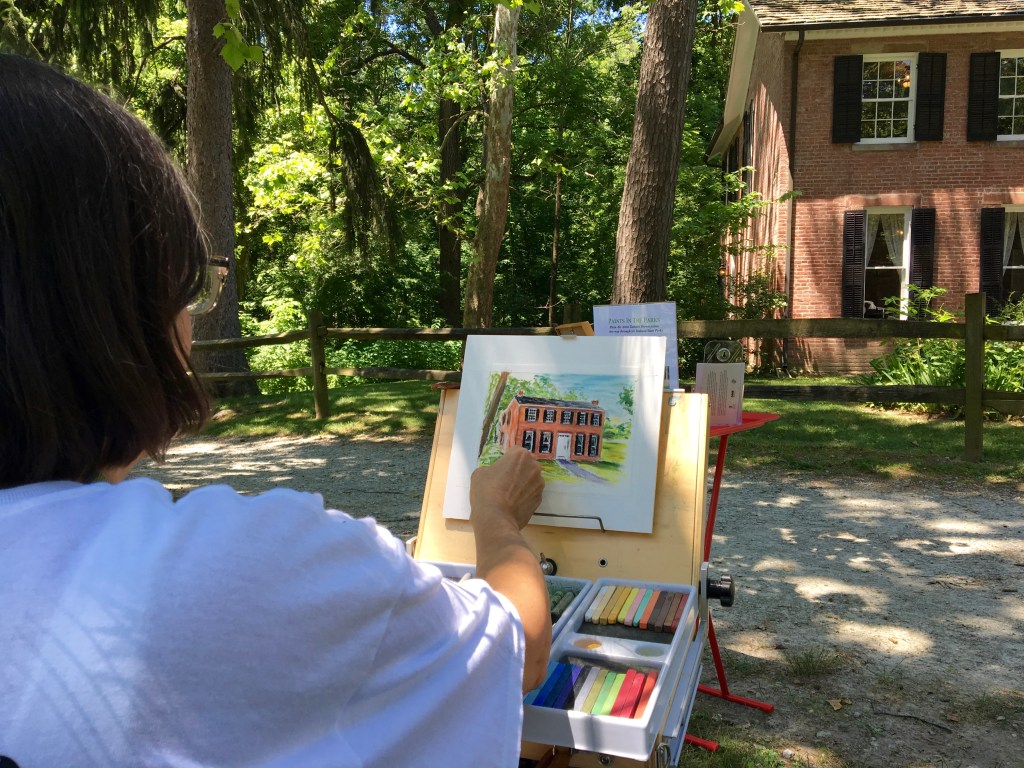
My visit to Mounds State Park last Saturday was full of sunshine, painting and chats about art with new park friends. One of the smallest parks in the Indiana state park system, Mounds isn’t as well known as some of its larger and more scenic counterparts but the mysterious earthworks resting amid wooded trails and the White River, as well as the historic Bronnenberg House, make a visit to the Mounds worthwhile.

This 290-acre park features 10 unique earthworks built by prehistoric Indians known as the Adena-Hopewell people. The largest earthwork, the Great Mound, is believed to have been constructed around 160 B.C. Archaeological surveys indicate the mounds were used as gathering places for religious ceremonies from where astronomical alignments like the summer and winter solstices can be viewed.

The Federal-style Bronnenberg House is a lasting reminder of early settlers who recognized the uniqueness of this area and protected the earthworks from looters and farming practices. Despite the construction of an amusement park and railroad in the early 1900s, the Bronnenberg family actively fought to preserve the mounds. Along with the house, the prehistoric earthworks became part of the state park in 1930. The fully-restored brick structure seen today was originally built around 1850 and is open for tours.

Throughout the day over 85 visitors stopped or strolled by and I had the pleasure of creating art at the Great Mound in the morning with two new friends who brought their own art supplies ready to draw! In the afternoon 20 kids and adults took me up on my challenge to try out the waterbrushes and watercolor field kits. After attending a birthday party celebrating the Centennial of the Indiana state parks, we stuck around for drumming and dance by the Miami Nation of Indiana that took place inside the Great Mound this year.

Like the Bronnenbergs I recognize the uniqueness of this particular park and its earthworks. Painting in this ancient place fills me with peace and a sacred sense of wonder. Often overlooked despite its close proximity to Indianapolis and I-69, I chose this particular park to bring attention to its beauty and special charm, grateful to those who protected and preserved the Mounds’ special magic over the years.

Falling For Clifty Falls

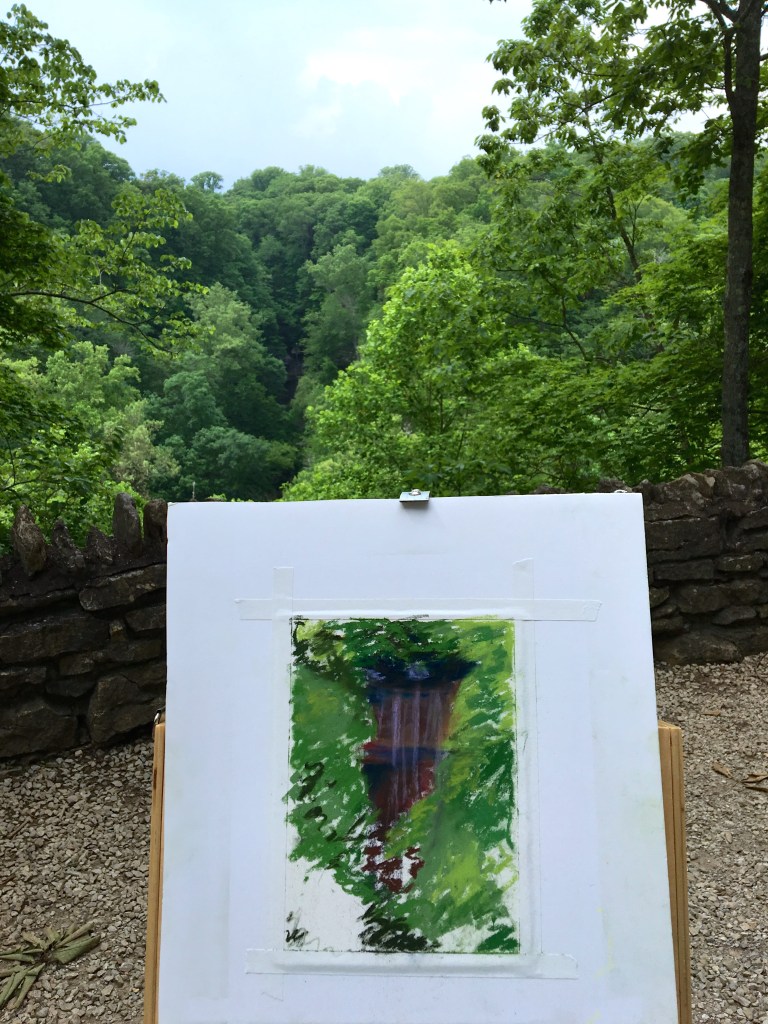
This past Memorial Day weekend found me painting up a storm at Clifty Falls State Park near the mighty Ohio river and Madison, Indiana. Created by Ice Age glaciers millions of years ago, the waterfall that has cut away the soft shale from hard limestone bedrock can be found some two miles away from where it first began on the Ohio river banks leaving a deep canyon in its wake. Sixty feet high and supplied by this year’s ample spring rains, I could hear the roar of Big Clifty while I set up my easel for the morning demonstration.

My painting spot was one of several prime viewing areas protected by stone walls built in the 1930s by the Civilian Conservation Corps where Brad Hessans, the park’s very knowledgeable interpretive naturalist, stopped to point out fossils embedded in the stones. Creek beds and rock formations throughout the park hold many examples of fossils from an ancient marine ecosystem full of corals and brachiopods.

The campgrounds and inn were also full at Clifty for the holiday weekend and I was able to engage over one hundred visitors throughout the day on Saturday at several locations in the park. I worked on a small oil painting of the Falls in the morning and a pastel of a long-range view of Clifty Falls from a lookout point on the trail in the afternoon. The trails range from rugged to easy and there’s plenty to do in the park as well as the nearby cities of Madison and Louisville.

Established in 1920 at the suggestion of Richard Lieber, father of the Indiana state park system, Clifty Falls is the first of six state parks I’ll visit this summer and fall. If you get the chance I encourage you to come visit Clifty’s stunning waterfalls and scenic overlooks. My next stop in June is Mounds State Park near Anderson, Indiana. Until then, grab some supplies and go make some art outside!